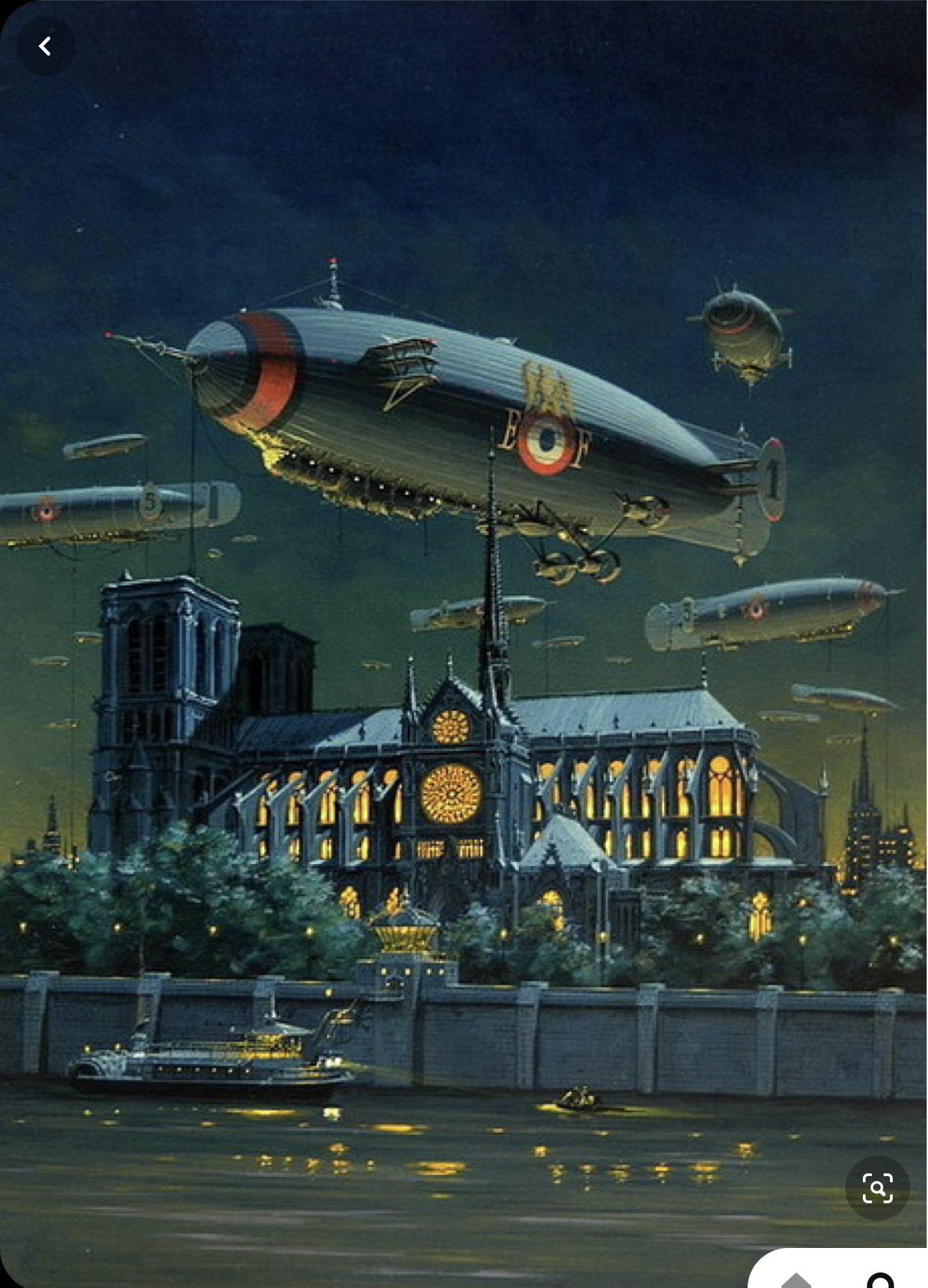
The Destruction of Notre-Dame is the cosmological hinge event in which the Time Bandits detonated an explosive of pure chaos beneath Notre-Dame de Paris, closing the Templar cycle of the Ivory Labyrinth and opening the cycle of the Regulators. Its main consequence was the descent of Ärsvan to the Ante-Inferno as a damned Templar.
| Type | Event |
| Location | Notre-Dame de Paris and the crypt beneath it |
| Date | Not fixed (see Conflicting accounts) |
| Perpetrators | Time Bandits, including Ärsvan |
| Spanish entry | La destrucción de Notre Dame |
Background
The cathedral was the visible layer over a secret Templar geography. Beneath it lay the Ivory Labyrinth, last seat of the Order of the Temple in its post-Jerusalem phase, with the Sancta Sanctorum at its center. Many cathedrals work this way; Notre-Dame was among the most charged.
The Sancta Sanctorum, the crypt under the high altar, held:
- the operative labyrinth, a ritual path, with Ariadna at its door;
- Templar relics of the original Jerusalem period;
- the black form of the split Master, Hugues de Payens, never fully sealed;
- residual infernal air seeping from the Pit through cosmological cracks.
In its last centuries the crypt was no longer fully Templar: infernal presence grew, and its guardian knights were forced into ever more compromised doctrine.
The operation
The Time Bandits placed the detonator in the crypt. Ärsvan was among them, with other agents whose names survive only in part. Their purpose was to close the Templar cycle before the infernal presence could open onto the surface. The detonation was meant to achieve four things at once:
- close the operative labyrinth;
- free Ariadna from her office as guardian;
- let the new cycle, the Regulators, enter;
- force the last Templar down to the Ante-Inferno as one of the Lost Ones.
The sphere of obliteration
Seconds before the detonation, Ser No Ser, who crosses the planes without a name, appeared in the crypt carrying a sphere of obliteration, an object that erases its bearer from the record of the extended universe, and offered it to whoever would touch it. By the labyrinth’s geometry it was meant for Ariadna. Ärsvan touched it first and was obliterated so that she would live.
Obliteration removed him from the record of the extended cosmos but not from the infernal one: through the Ante-Inferno, already open in the cracks, it brought him to the threshold of the Pit as a Lost One, the “damned Templar of the profaned chapel”.
The detonation
- It brought down the cathedral (high altar, nave, towers, windows) and the Templar crypt.
- It sealed the labyrinth, burying Hugues de Payens’s black form, the relics and the infernal air under rubble.
- It freed Ariadna: the exit, which for centuries had required the silver ball of thread, opened.
- It opened Paris: the city’s surface, until then closed to the extended cosmos by the cathedral’s sacred cover, opened to the Regulators.
The pure chaos destroyed selectively: the cathedral fell, but the apparatus of the extended cosmos did not collapse.
Aftermath
Ärsvan was displaced to the Ante-Inferno. There he has the form of a Templar in preserved Baphomet armor, praying in the profaned chapel of the Castle of Siegling. His memory of the event is fragmentary: he remembers Ariadna at the doors, the sphere and his decision, but not the detonation. The Pit’s apparatus eases such transitions with partial forgetting.
After the fall, the Regulators entered the next cycle, and the Eiffel Tower Tournament of 1890 A.D.A. took place in the geography it freed, as did the work of Sven, Helter and Bertrand. Ariadna, freed, took on a modified function and later descended to the Pit as well, as Ariadna / Genoveva / Bebona, with red cape, scythe and an aura of fire.
Conflicting accounts
- The image caption dates the destruction to 1946, “the place where the Regulators marched forward in time”.
- The Chorus of the Descent fixes no date and suggests the 19th century, possibly its first half or middle, so that the 1890 A.D.A. Tournament could take place in already opened geography.
- It also records possible echoes with fires and partial collapses of a terrestrial Notre-Dame in the 19th or 21st century.
Gallery