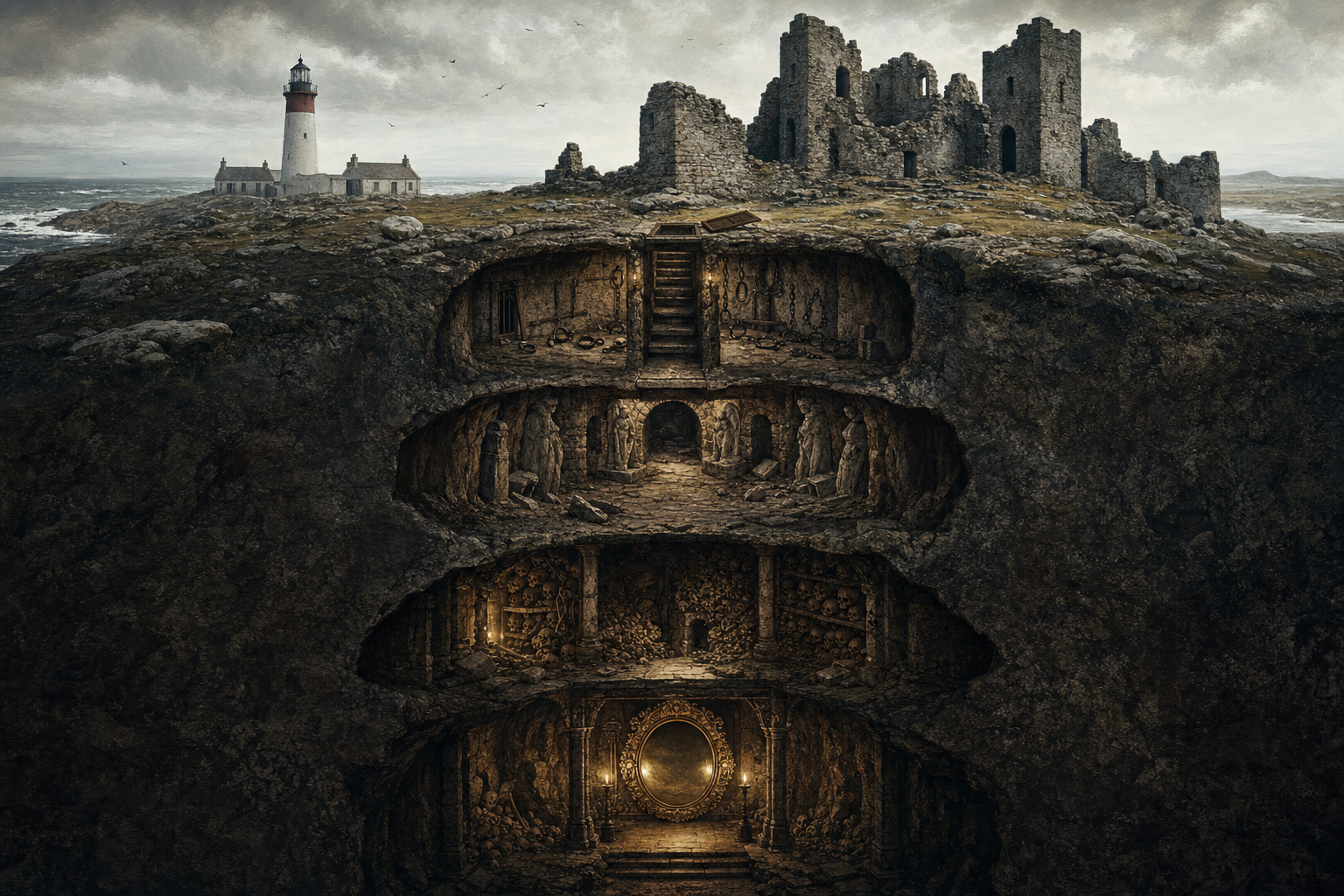
The ruined castle and dungeons are a stone ruin beside the lighthouse on the Malvinas whose trapdoor leads down to cellars and dungeons cut into the rock. The underground belongs to the fish-men of the Esoteric Order of Dagon and ends in the hall of the brass mirror.
| Type | Place (ruin, dungeon) |
| Location | Malvinas Islands, beside the lighthouse |
| Era | 1966 |
| Owners | Esoteric Order of Dagon |
| Houses of the Cycle | ☷ House of the Descent |
| Spanish entry | El castillo en ruinas y las mazmorras |
The ruin
The castle stands on hard ground that looks like an outgrowth of the rock itself; from afar it promises only rubble. Beneath the fallen walls a trapdoor opens onto a network of cellars and dungeons.
The chronicle links it to the old Welsh stones of Caerleon, the Kalion on Usk: the same castle recognizes Antonio — the sailor whom the Welsh lineage also calls “Alex” — and no one else of the group. Among the newcomers the ruin is known as Alex’s castle.
The dungeons
The halls hold pyroclastic statues: twisted bodies turned to salt or ash that crumble at a touch, petrified as if looking at what they should not, like Lot’s wife. Walking these corridors costs sanity that does not fully return, with vertigo and a pull toward the void.
Deeper lies a human ossuary: gnawed bones, some old and some recent, whose teeth marks show cannibalism that has not ceased. There are cells with shackles; in one, locked up naked as ransom, is Grandmother Echegoyen, whom the group frees. The chambers also hold remains of Afro-coastal rites: burned-down candles, offerings, animal bones.
The whole underground belongs to the fish-men of the Order of Dagon, who worship Cthulhu and what dreams at the bottom of the sea. The dungeon is their larder and prison. From the same lineage and confinement comes the Hybrid Son.
The hall of the mirror
The hall of the brass mirror dominates the rest: a huge mirror of polished bronze, as tall as two men, its frame covered in Gaelic inscriptions, facing due north. Black marks and fires laid in circles on the floor before it show its use as a summoning device. When the stone-egg into which the zirconium turned is exposed before it, the egg opens an eye, and through it emerge the manifestations the rite calls.
These are the invisible beings the chronicle spells Joyboard: kin to the chthonians, they dwell between spaces and feed on the psychic energy of depression, suicide and the fire of passion. The salt statues and the suicides of the nearby coast are their harvest. The Gaelic legends on the frame — dragons, masks, a face that takes the mask of the devil — are their portrait.