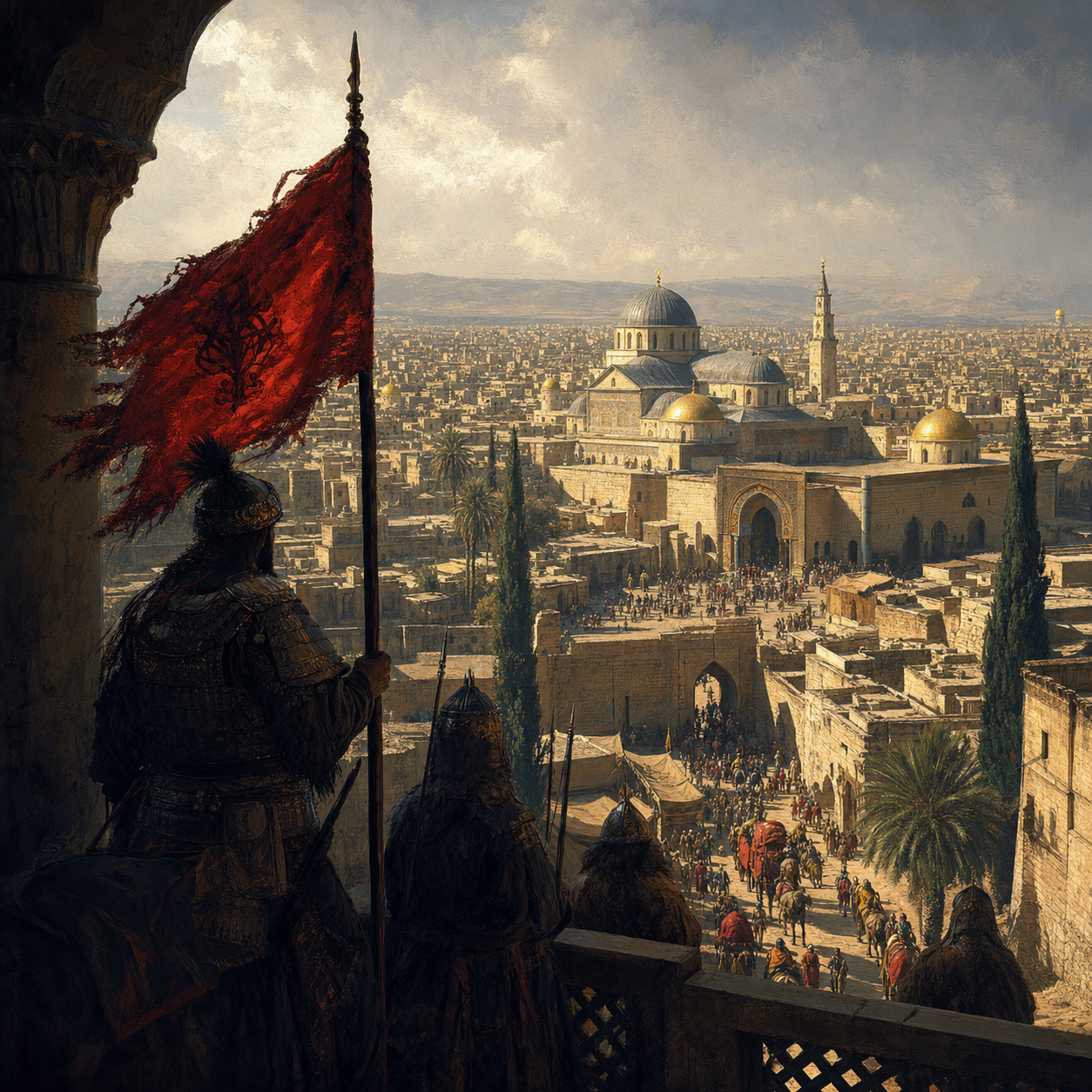
Damascus is a powerful Muslim city of the Holy Land in the Florenzen chronicle (1300), walled, domed and in very good condition, where Jacques de Molay is quartered gathering troops.
| Type | Place (city) |
| Location | Syria |
| Spanish entry | Damasco |
Description
It lies three or four days across the desert from Jericho (“Damascus is much farther”); one fast company did it in two. It has double and triple walls, domes and “mosques everywhere”.
The city is entered in layers: metal portcullises cut the inner passages and close. A warning at the inner gates: “It is not a place that has access to everything.” The people are Muslim and no cross is seen in the street; Christians enter by infiltration. Near the palace stand an undestroyed church and a chapel with a Red Cross banner.
Military role
Troops are garrisoned here, and Molay has a parade ground to prepare them. Behind its own barriers lies a redoubt that once held an embassy (“perhaps the crusaders”) and still bears Molay’s coat of arms. Molay’s movements depend on what gathers here; the city is both target and danger.
The coffee house
A tavern that is really a coffee house serves a hot herbal drink; whether it is coffee is not settled (“it is a healthy herb”).
Conflicting accounts
- Described as powerful and in very good condition, but elsewhere as “almost empty at this time”.
Open questions
- Who opens the portcullises; why the palace church stands and who keeps the banner.
- Who governs Damascus, and under what authority and with how many troops Molay is garrisoned there.