This name refers to different figures in 2 worlds; the versions are not merged.
Ariadna is, in Antiterra, the king’s daughter whose golden thread leads out of the Labyrinth, and in Vala, a name borne by several distinct figures.
Antiterra
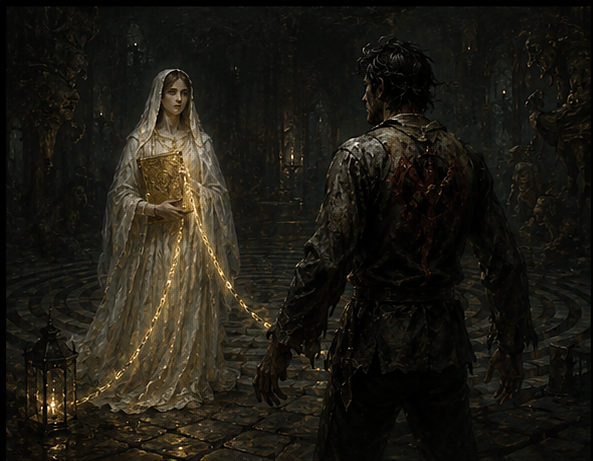
Ariadna is the daughter of the King of “the zone”, a demonil estrella caída (“demonic fallen star”), and lady of the camp at the gates of the Labyrinth, which is read as space-time itself. There is one Ariadna, and one ball of thread per chosen one.
Description
She is “a great beautiful woman”, informally la bebota Ariadna (“the babe Ariadna”). She has a second form: at moments she appears horned and “more avisoide” (unglossed); she bites herself and “her little ears come out”. These demonic traits appear and recede, and are linked to exposure to the Abyss.
History
The Templars camp at the gates of the Labyrinth; there Ärsvan met her. She has also been seen away from the camp, traveling between times, and was held prisoner. Her sacrifice took a million souls with it. She still holds unspoken knowledge of how the devastation is to be resolved, which she could not pass on while imprisoned.
The thread
Her ball of thread is wool, “all golden, like a golden cord”, with a small silver center, “Ariadna’s protection”; the silver is the magical part. The end is tied at the entrance and the ball thrown inward, so that the traveler “does not get lost” on the way back. The thread is not bought but received by naming: “Ariadna trusted only her desire and the one she named.” She chooses by desire, not merit or lineage; the problem attributed to her is “the relationship between love and the divine”. The records hold one such thread, the one given to Alexan.
In the cosmology of Uchronic Paris, “time is a formula for the labyrinth”: the labyrinth is space-time, the thread is time, and Ariadna’s thread is literally an exit formula. One can “communicate with Ariadna”, and statements about time and reality are quoted from her (“Ariadna told me this”). Such communication is established with Swann.
Conflicting accounts
- In the legend within the world’s cosmology, Theseus falls in love with her and she helps him escape the labyrinth.
- In one account Ärsvan calls her “my future betrothed”, with nuptials never consummated; the same account names Reynaud, and the two forms of the betrothed are not reconciled.
- Another account makes her the mother of Swann, whose father is Ärsvan.
- An unfixed form, “the girl of arismán” (Arismán, Arzimán), may be Ärsvan or a third person.
Open questions
- What a demonil estrella caída is, and Ariadna’s standing in that category.
- What she knows about the devastation; who held her prisoner, and where.
- Whether the cord and the time formula are one thing in two registers.
- How the sacrifice of the million souls happened, and when relative to her imprisonment.
- Where “the zone” is, and how large the camp is.
- What “between Ariadna and the water” means.
- What triggers the horned form, and whether it is reversible.
- Her clothing, age and voice are not recorded.
Vala
In Vala, Ariadna is a name the world repeats. The Library of Babel holds entries for several significant Ariadnas (“that is another Ariadna, that one is de bebichitos, she renounced her cult”). They are counted, not unified.
- The scythe-bearer, in her “last evolution”, carries an oversized, golden-edged scythe and is “demoniacal”. An aura of fire burns whoever comes near; the scythe strikes separately. She bears a black thread that is a lit fuse burning downward.
- The head in the crypt: an Ariadna, a black elf who had suffered, dead and reduced to a head in a crypt, where the warning “Never look too far sideways” was recorded. Such elves were called “an Ariadna”.
- The one in the castle stands beside the gesture of “the chained one who saves children” and marks “the compass of good and redemption”; whoever imitates her adopts that gesture.
- The familiar spirit can be summoned and is not exclusive: one companion said “I summoned Ariadna, I have one”.
- The group’s companion appears only “in her version like that, la mujer de comofa”.
A “cord of Ariadna” is sought as something one might carry; where it is obtained and what it does are unrecorded. A golden thread was given earlier.
As a voice, Ariadna warns: with Etimita, “the two said beware of Kossuth. There is a sword.” As an image she serves to accuse abandonment: Hecate invokes her in the narrative of Dis to say “you left me for your friends”. The name carries two stable poles, betrayal and abandonment, and good and redemption. One Ariadna renounced a cult, so at least one had a cult of her own.
Open questions
- How many Ariadnas there are; whether “an Ariadna” is a name, a title or a kind of creature.
- Which cult was renounced; what de bebichitos means.
- Etimita has no fixed spelling or place in any roster.
- What the “last evolution” belongs to.
- Whether the black thread is the golden one transformed, and whether the cord belongs to the same series.
- Why the scythe-bearer also carries the thread.
- The group’s companion and the castle Ariadna are not described.
- Whether the scythe-bearer is enemy, ally or neither.
Gallery

See also
- Ivory Labyrinth
- Swann
- Barbarella, the aunt, said in Sogol to be of her distant blood
- Templars
- Paris