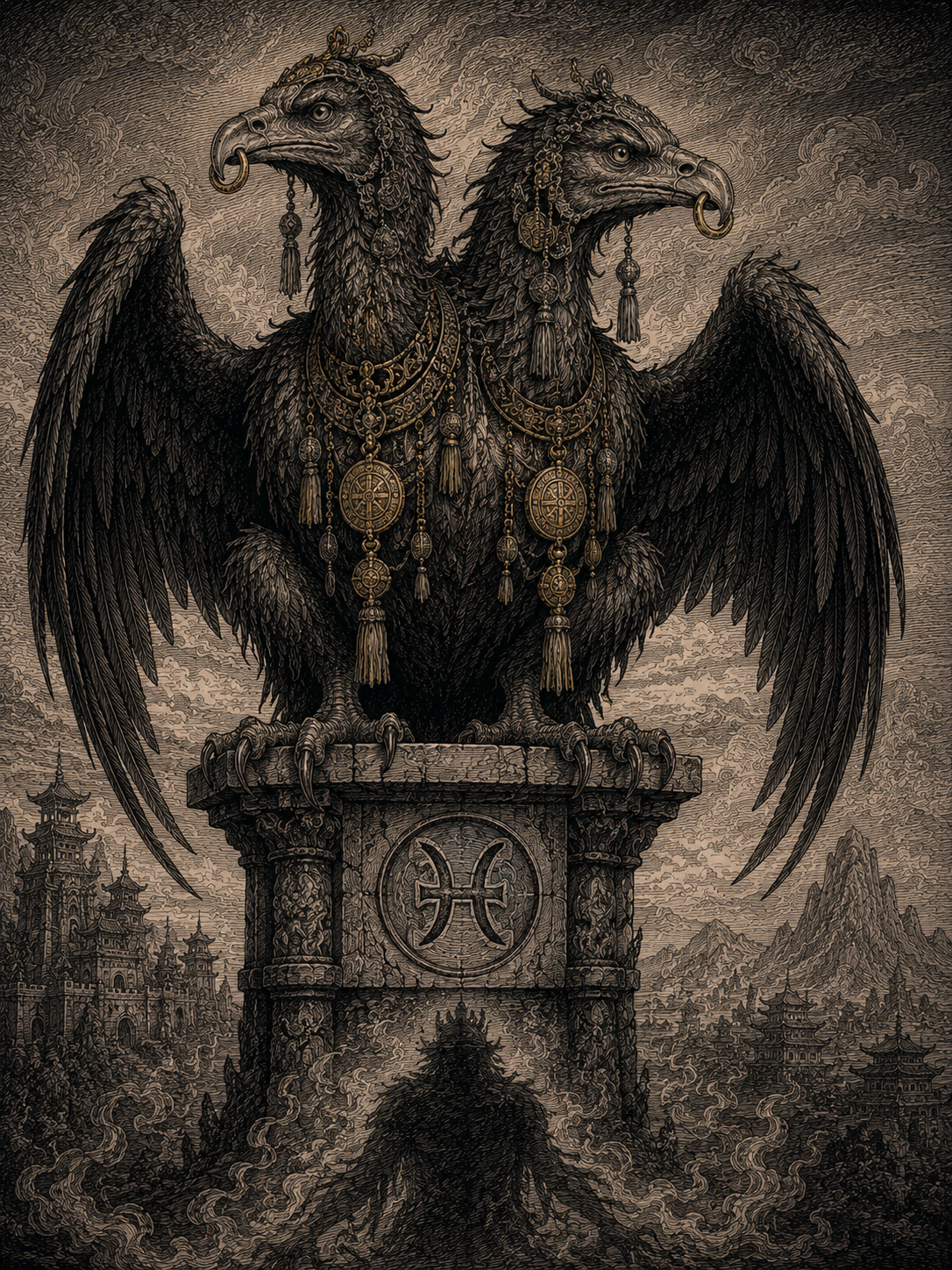
Great Khan is the title of a single sovereign of the East: in Antiterra, the ruler of the Mongol empire that dominates the known world; in Vala, the two-headed, vulture-headed Lord of Nightmares, once a guardian of the Pisces platform.
This name refers to different figures in 2 worlds; the versions are not merged.
| Type | Entity (sovereign) |
| Worlds | Antiterra; Vala |
| Spanish entry | Gran Khan |
In Antiterra
Signs of the empire
The empire’s color is black, on banners, pennants and standards. A ship sails above the clouds: a dragon-head figurehead, a pagoda for a sterncastle, sails and cannons, “above all, a huge dragon cannon”, and “a black pennant of the great kingdom of the Mongol empire”. It can be darkened “with some kind of spell”.
Realm
There is one Great Khan, and he rules “the known world”. The kingdoms of Seif, Erdbar, Tuchmit, Khet, Beluna and the nomad tigers pay him tribute. With the West there is an agreement, not conquest: “the Tartars did not conquer them in Europe, an agreement was reached”. His people patrol there, and his court receives tributaries and hostages from subject kingdoms.
His era is associated with Urga (Urga Bator, renamed Ulam Bator only around 1600, “still far off”; the archive marks this statement as doubtful). Through the Han, “the ancient Khan, the king of Teotihuacan”, his name reaches a throne on the other side of the world, linked to “the triple kingdom of the two magi kings”.
Law
The empire is bureaucratic but keeps no register: instead of a passport, each person carries an astrological chart, from which the empire knows them. A summons cannot be refused: “you are summoned, and one cannot fail to attend the summons”. Laws govern “games, tributes and drinks”; all were changed after “the war”.
One rule is stated without exception: «La ley del Khan es muy estricta. Los regalos, los tributos y los rehenes no se devuelven.» (“The Khan’s law is very strict. Gifts, tributes and hostages are not returned.“) Tribute includes people: girls handed over live at the court and are taught noble arts, fencing and sorcery. Imperial authority overrides local governments even over life and death: invoking “these are matters of the Khan… matters of State” can halt an execution.
Caravans and emissaries
The caravan is a train of giant platforms drawn by beasts of burden called huelles, carrying tents, soldiers, mandarin counselors, servants, camels and the tribute: a hundred beasts, a hundred soldiers, three counselors. It copies “the model of the first caravan… which was Genghis’s”, reduced: central tent, advisers, porters, “some guards, they don’t have the hordes following behind. But camels, yes.” A caravan of identical composition is said to bear the name of Isidora.
Emissaries carry symbols and insignia as “agents of the Khan”; heralds wait with standards bearing the insignia of “the faithful of the Great Khan”. The delegation is real power (“we are the emissaries of the Khan and that gives us power enough”), but its symbols can be rejected or reviled.
The commission
With his empire mastered, the Khan commissions Marco Polo to find and report on cities he names: “I will tell you cities that you have to find.” The Invisible Cities were corrupted by the shadow, and his emissaries sought to redeem them; that redemption is the axis of the gesta (campaign-cycle). The same throne led the fight against the shadow. The voices are divided: “for us he is a tyrant… but it is also true that he has led the resistance, the defense against the shadows.”
Lineage
Genghis Khan shook the lands of the black quitones of the east and sealed an alliance by giving his daughter’s hand; his caravan is the model of the current ones. Kublai descends from him. The Han is a king awakened or revealed. In cosmological register, the Great Khan is named together with Cakravartin, sovereign of the wheel.
Conflicting accounts
- Three accounts of his body: he is Kublai Khan, “a fatter one, Chinese”, heir of Genghis; he is an immortal reborn in each successor (recorded as rumor); he is “a two-headed Brokk, a Dual Brokk”, a dragonic entity. The first and third are stated in the indicative.
- The caravan numbers “almost a hundred people” in one account and “some 100,000 people in all” in another.
- One passage lists the Great Khan among enemy factions, contradicting his role as patron of the company.
- Another Khan in the records calls himself a “buffer state”, protects the Buddha’s son, is kidnapped in a forest, heads a church and has killed blacks, Arabs and pagans; whether he is the sovereign, a usurper or a regional figure of Urga is undecided.
Open questions
- Where the court is, and who issues and reads the astrological charts.
- How many dragon ships exist and who commands them; what a huelle is.
- Which war preceded the change of laws.
- Whether the Khan, the Han and the Cakravartin are one power or three.
In Vala
Nature
“A nasty force has been released, which is the great Khan of nightmares”, and since then the worlds have lost their balance. He is a sovereign, not a cataclysm: he “prefers people alive, although… he could be a damned tyrant.”
He is a Vasus, of the lineage of beings of the old wisdom of the East, seen “as an oriental sovereign” in garb charged with symbols of imperial and draconic power. He has two vulture heads that can act separately. One was cut off in an execution and he survived with the other: the double head is his “condition of being able to be executed and survive”.
The title is single, both office and person, and passes by death: he “became the true Great Khan” after killing Ov Kalimni.
The divided king
In the previous world the Pisces platform had two guardians, opposed and enemies from the beginning: the Great Khan in the east and the Cakravartin in the west, with Atlantis (“Atlantis was the west while the great Khan belonged to the east”). Yet the king was “the conjunction of the Khan of Nightmares and the old Cakravartin, who is the king of the Atlantic”.
Instruments of rule
- A black pennant, a “black mark on the tents”, places a tent under the protection of the Gran Cali empire.
- An invincible black sphere “at his command” acts as a black hole at his will.
- Games: “He had rules at the table, but sometimes he held colosseums”, deadly contests under specific rules, used to subdue vassals and enemies.
- He tamed the flying whales (“he has made the whales fly”) and through that “will gain another power”.
- His regime is one of subjection, “where knowledge will be kept only by” a few. His hordes advance in the present.
- Bertrand is recorded only as interested in “ancient kingdoms and hordes” and linked to the Gran Cali mark.
Dream and the pearl
His domain is the world of dreams, which is his channel: messages are sent “only from the plane of dream” and reach only those able to receive them. The pearl given to the Cakravartin is one such message, addressed “to this new incarnation”. It asks for a reunion, “to build the king the same again”; the world’s hope depends on whether they fuse again.
Lesh Khan
The records hold another figure, Lesh Khan, not merged with the Great Khan: a “primordial danger that comes from the south”, an orc king and a giant among orcs, always seen in armor of opaque, nearly black metal covering his whole body. Four chains of about three meters, with collars and shackles at their ends, hang from his belt. He “always takes something from his victims as a souvenir. Something of their gear, part of the body. The whole body.” He worships Gruumsh, the one-eyed orc god, “he who never sleeps”. He is called an “eternal form” and a descendant of Tiamat; an earlier, worse name “that precedes Lesh Khan” is murmured.
Open questions
- Who executed him, and when he lost the head.
- Whether Gran Cali is his empire, his imperial name or a distinct power.
- The rules of the colosseums; the matter, size and limits of the black sphere.
- What the rebuilt king would be and rule; where his court is, if anywhere but in dream.
- Whether Lesh Khan is the Great Khan, another Khan or an incarnation of him; whether “Lesh Khan” and “Lesh-Kamp” are one; what the earlier name is.