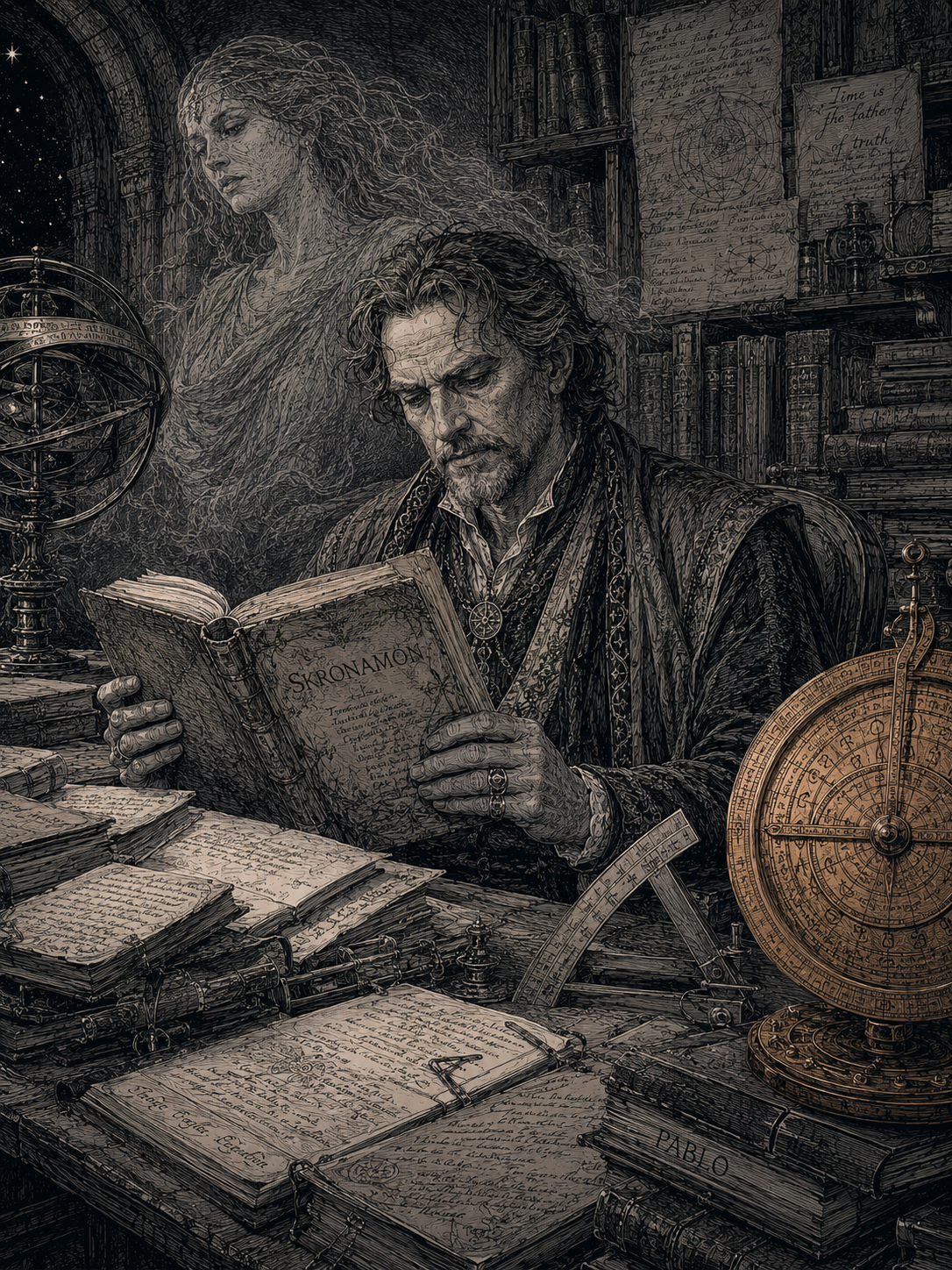
Kronamon is a deceived titan, the sacrificed son of the mage Pablo, who became flesh, was martyred and beheaded, and in 1120 left his titan body to ascend as patron god of time and uchrony. The ascent was planned but came out “half truncated”. He is the center of chronal Christianity, in whose carols “Christ is Kronamon”.
| Type | Character (god of time) |
| Domain | Time, uchrony |
| Key date | 1120 |
| Spanish entry | Kronamon |
The divided body
His prison had to be broken for uchrony to work. The titan was left in three parts:
- Head — petrified and turned into a cave entrance that can be walked inside. When the Ivory Templars arrived (those who condemned him, Pablo among them), “his blood and his biotic essence were already petrified”. The head was first shot, then mined with an already petrified scythe. A gargoyle is embedded in its eye, and the gargoyle held a splinter of the True Cross, found inside.
- Body — carried by someone to the end of the universe.
- Bones — “forgotten”.
A deep voice remains, which certain people can hear and channel, and which answers questions.
Guarantor of time
Kronamon sits at the top of the Tetractis pyramid and sustains the stability of time with his bones and body. His dismemberment causes temporal chaos, and his death opened the way for the Horsemen of the Apocalypse to accumulate power. By breaking the planar barriers it “changed the objectual reality of how the cosmos works”: since then the dead appear and the boundaries between planes no longer hold. While the body, bones and head stay apart, uchrony works broken; winning Kronamon’s body is a declared cosmological struggle.
Chronal Christianity
His cult mirrors Christianity piece by piece: incarnation and martyrdom in place of the Passion, beheading in place of crucifixion, a Bible of Kronamon with its rules and a section equivalent to the Apocalypse, his writings (the hidden creed) in scrolls found at the Dead Sea, temples in Uchronic Paris that once belonged to other gods, and carols that sing “Christ is Kronamon”. This chronal Christianity differs from traditional pagan Christianity and identifies Christ with Kronamon.
- Public face: church, temples, prophets, and the blessing that the times must belong to the sovereign.
- Secret face: a hidden creed, proper to chronomancers, of preserving knowledge across the ages.
Worship and doctrine
- Contact is made by channeling his divine arts, by formal pact, or by “knocking on Kronamon’s door”, which seems limited to once per day.
- His doctrine commands protecting knowledge across times and forbids time travel without a specific reason and spiritual preparation.
- Draga Machine calls herself “one of the chosen of Kronamon”. The office of prophet of the god Kronamon exists and can be assumed. Lázaro received a prophetic date “told by Kronamon himself”. He is linked to the true Veronica as “the possibility”.
Prophecies and the hour
His prophecy for Paris: if the Regulators go on living, eternal bombs will fall on Paris — “not one, not two, but the century of wars”. The hora de la ciega (“hour of the blind woman”) is the moment Kronamon’s head fell, linked to the cycle of the Pleiades. The year 1120 holds his ascent and the fall of the head.
Reach
He has no equivalent in the pantheon, and his ascent is recent within the pantheon of Uchronic Paris. His cult is widespread but neither universal nor ancient. He is linked to Armenia and the ritual cycles of Kumal; a clock of Kronamon turns in London, seen in a vision with the Tower and the Thames. In the Valley of Death “there is no presence of Kronamon”. There is a plan to insert him “like a Trojan” into Alpha Centauri.
Conflicting accounts
- One version: “Kronamon answers questions but is dead, he is not a god”.
- Others call him patron god of time and hold that “he clearly was a god”.
Open questions
- Where the head-cave lies, and who carried the body to the end of the universe, and why.
- Who beheaded him, and whether that is the same event as the martyrdom of his incarnation.
- What the acron gear (engranaje acrón), a stolen critical piece of the temporal machinery, has to do with him.
- Whether Croma, of whom Kronamon would be a chosen one (a single mention), is a separate god or a garbled form of his name.
- Who the Regulators are; how the office of prophet is gained and who runs the church.
- The temples, Bible and London clock are not physically described.