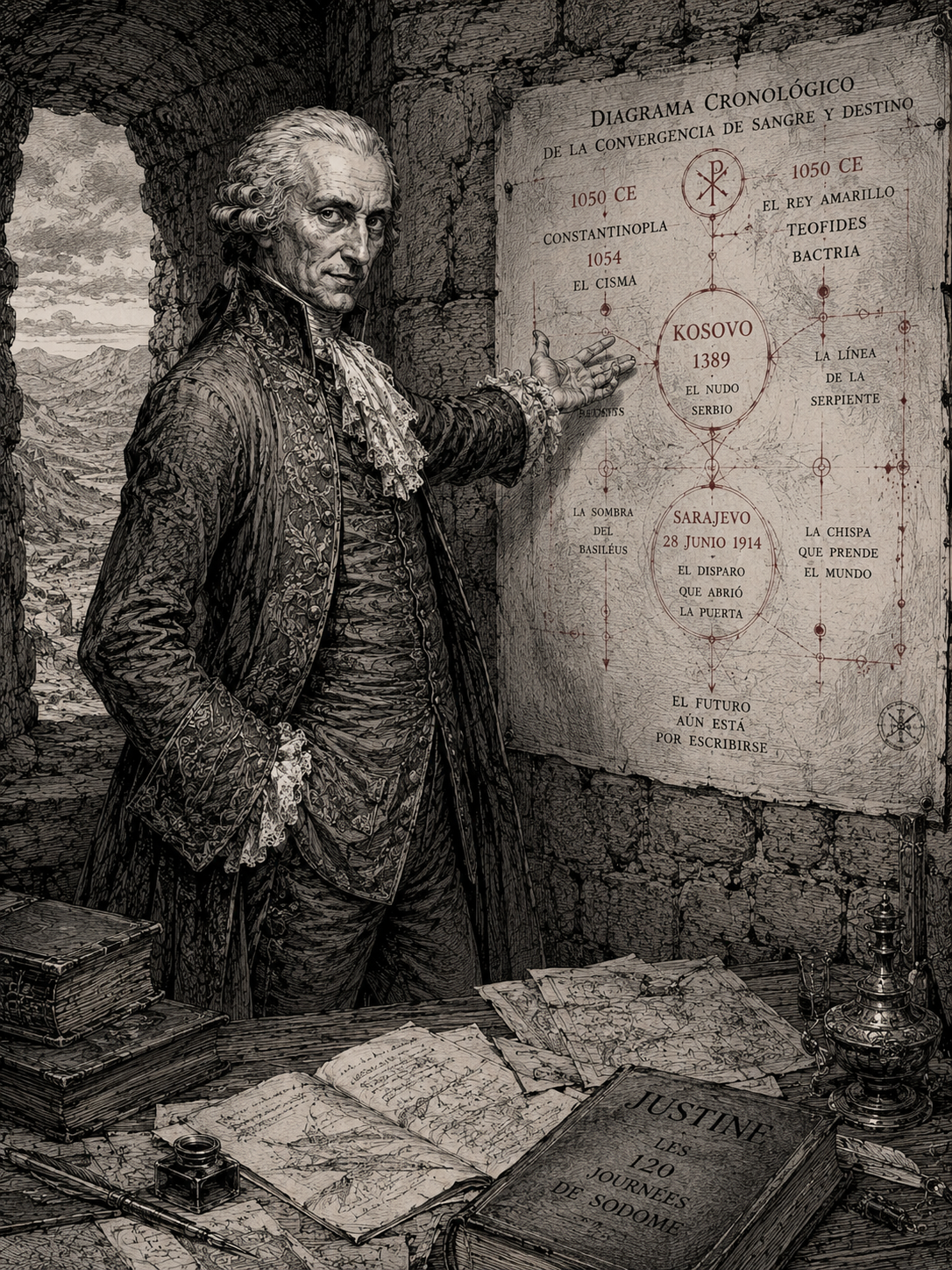
The Marquis de Sade — Hugo is a composite figure of the chronomantic record: one person with two names, fusing the eighteenth-century libertine Marquis de Sade with a Hugo who is not fully identified. He spoke to the group from a tower in the Valley of Death and revealed hidden parts of the plot leading to Sarajevo 1914.
| Type | Character |
| Lineage | ”The devil’s family” |
| Chronicle | Uchronic Paris (Anatolian arc) |
| Houses of the Cycle | ※ House of the Name · ⌖ House of History · ⏳ House of Carnal Time · ✒ House of the Chronicler |
| Spanish entry | El Marqués de Sade — Hugo |
Identity
He says he belongs to “the devil’s family”, a direct genealogical tie to the greater demonic body, not a metaphor. This places him on the side of those who set the trap for the Uchronic Guards in the Sarajevo episode.
The tower encounter
In the Anatolian arc of the Uchronic Paris cycle the group met him in the tower; he was neither hostile nor friendly. He revealed:
- The death of Chronomon (Cronomon Heredeth) was also his apotheosis: “la apoteosis de ese señor del tiempo” (“the apotheosis of that lord of time”).
- The great assassination was planned over seventy years from 1050. The chronomantic chain ending at Sarajevo 1914 was prepared at a Byzantine Anatolian table and in circles tied to the Black Hand and Lotario.
- “Not all the forces wanted it”: factions were divided over the sacrifice, contradicting the popular account of unanimity around the Inevitable.
- “Un niño, un talvito” (“A child, a talvito”), about Kosovo: possibly Saint Vito as a child-chronomantic entity, or Vidovdan personified as a child who collects the day.
- With four generals eliminated, Turco-Serbian diplomacy would be possible.
Reliability
The Valley of Death lay under the fungal Mindscape, recorded in the 5-Year Loop; the tower was a spore zone inside the illusion. Everything he said may be true, false, or both. By chronomantic rule, what is revealed under mindscape is never entirely a lie: the illusion deforms rather than invents. His revelations are therefore held as strong hypotheses, not firm data.
Open questions
- Which Hugo: Victor Hugo, Hugues de Payens transposed in time, or the “Hugo Marques de Sade” popularized in the Belle Époque.