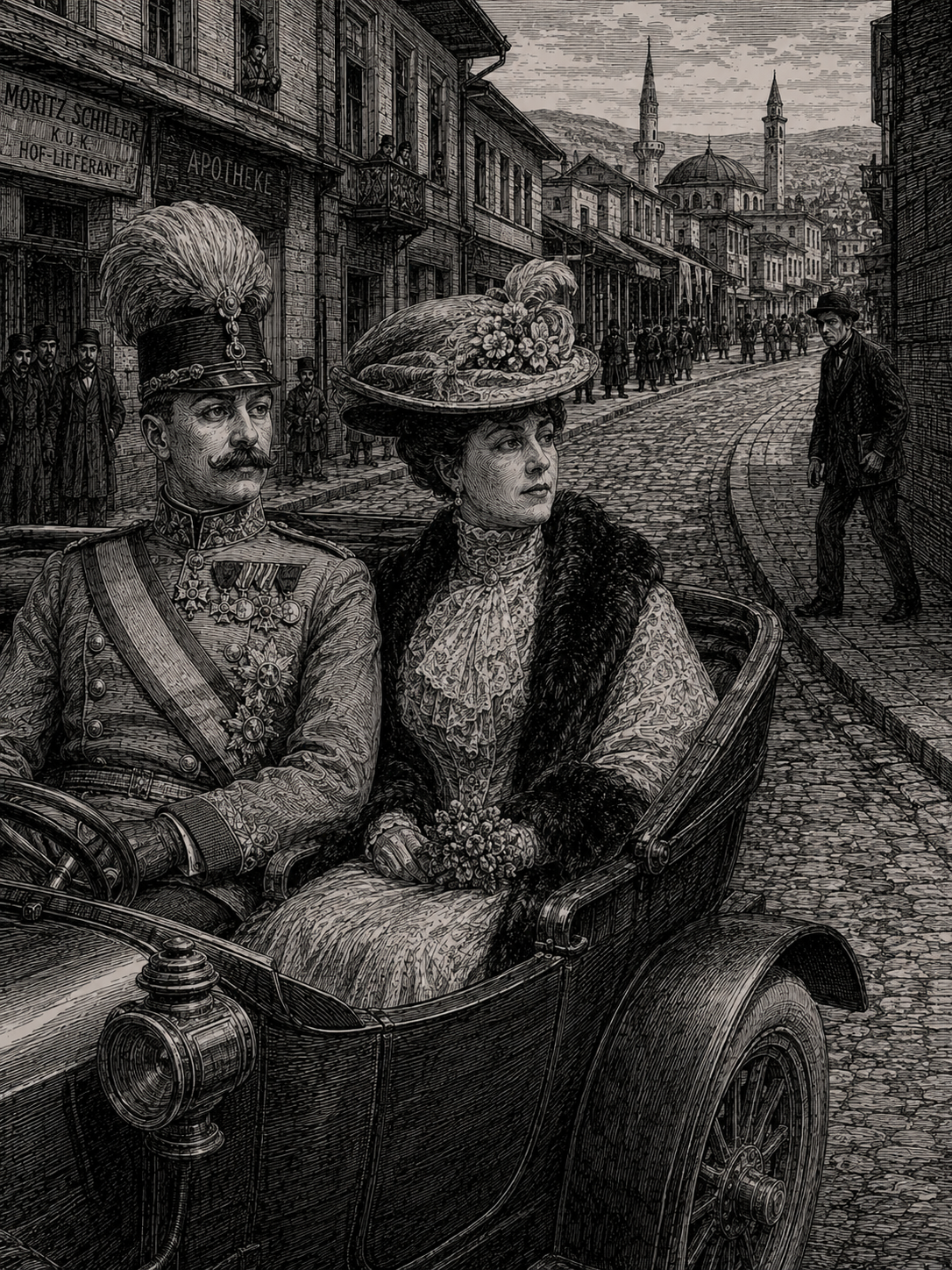
Franz Ferdinand of Austria-Este (Erzherzog Franz Ferdinand) is the heir to the throne of the Austro-Hungarian Empire, killed with his wife in Sarajevo on 28 June 1914. On the chronomantic axis of Uchronic Paris his assassination is both inevitable and manipulated.
| Type | Character (historical figure) |
| Born | 18 December 1863, Graz |
| Died | 28 June 1914, Sarajevo (Latin Bridge) |
| Spouse | Sophie Chotek, Duchess of Hohenberg |
| Relatives | Franz Joseph I (uncle and emperor) |
| Spanish entry | Archiduque Francisco Fernando de Austria |
Life
He is the nephew of Emperor Franz Joseph I. He became heir presumptive after the suicide of Prince Rudolf at Mayerling (1889) and the death of his own father in 1896.
His morganatic marriage to Sophie, outside Europe’s dynastic nobility, was an institutional scandal that the imperial court did not accept. He took humiliating terms — Sophie could not sit beside him at official ceremonies; their children were excluded from the succession — to live with the woman he loved.
By 1914 the empire assembled twelve nationalities (Germans, Hungarians, Czechs, Slovaks, Poles, Ukrainians, Slovenes, Croats, Serbs, Romanians, Italians, Jews). He was preparing a federal reform, the “United States of Greater Austria” (Trialismus or federal variants), which would have weakened Magyar dominance over the Slavs.
Assassination
28 June 1914 was his wedding anniversary. Sophie went with him to Sarajevo because in Bosnia, outside Viennese protocol, she could appear publicly as his wife. The Black Hand chose the date knowingly, aiming at the marriage as well as the heir: the two bullets killed a couple.
In common history he was shot by Gavrilo Princip. In the chronomantic record the killer is not Gavrilo alone but Claude Nauge acting under the fused identity of Cvjetko Popović, projected into the instant by the Simultaneous Circle as an Uchronic Guard under magical compulsion.
Sophie’s words, recorded by uchronic chronomancy — “Déjenme ir. Nos encontraremos en el pasado” (“Let me go. We will meet in the past”) — are not a common farewell but a promise of reunion in another temporal layer, recorded as still in force.
Significance
His murder also killed the reform plan: the Black Hand believed it was striking the centralized empire, but removed the reformer. The war it set off was, in part, a preventive defense by those who had lost the only interlocutor they could negotiate with.
The doctrine of the archive of the Plata, after reviewing the chain from Kosovo to Sarajevo, holds that his death was both:
- inevitable, as the cosmogonic cipher of a chain that Vidovdan — the day of Saint Vitus — had been preparing since the Battle of Kosovo in 1389;
- manipulated, as a tactical operation of the Black Hand and the Simultaneous Circle.
The “inevitable + manipulated” paradox applies to every magnicide the shared cosmos records; he is victim both of an attack and of a date (see Inevitable).
Conflicting accounts
- The main record says the killer was “not Gavrilo alone” but Claude Nauge as Popović.
- A gloss of the Decadian says instead that Gavrilo Princip “yields his place” to Claude Nauge.