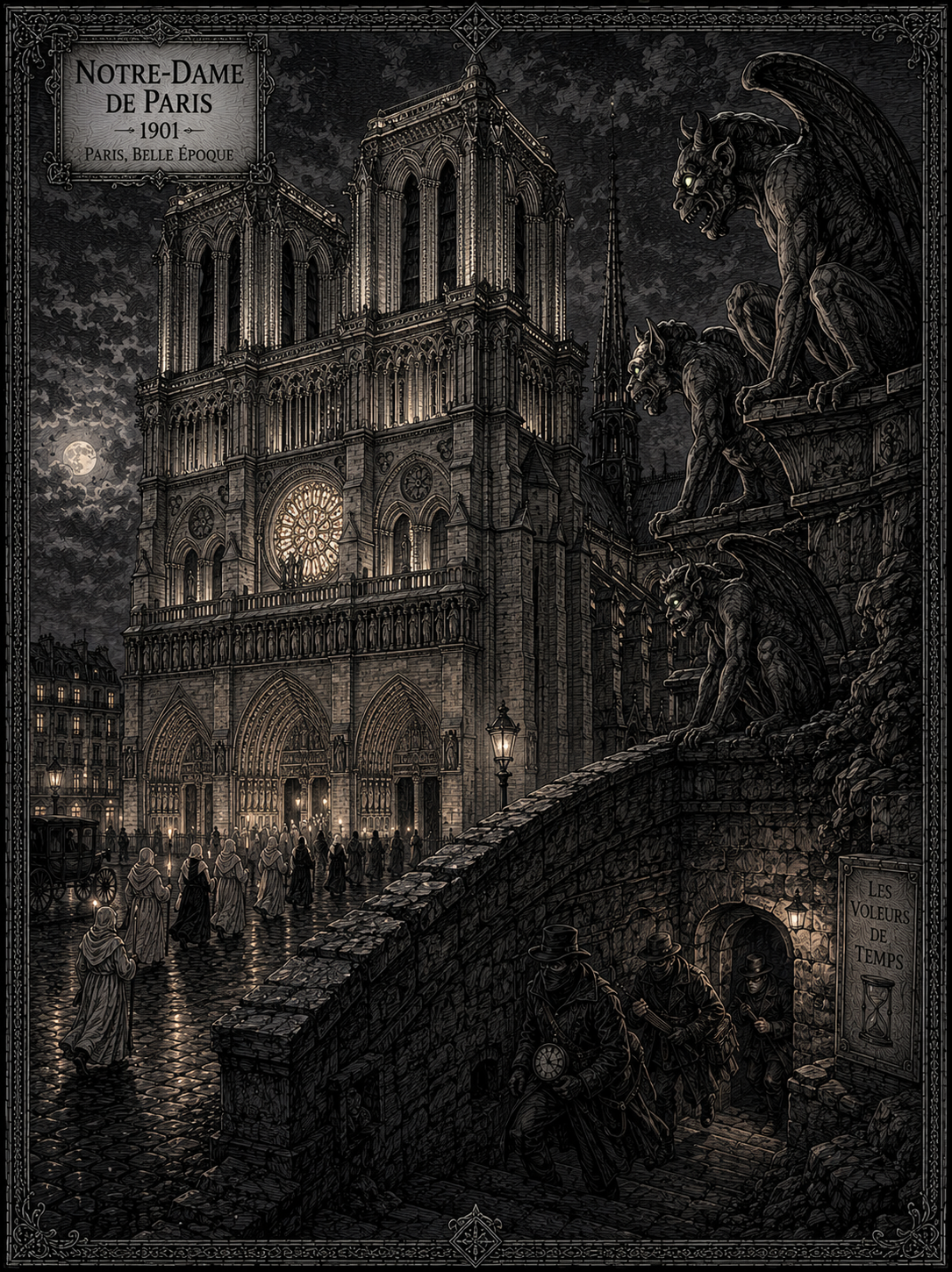
Notre-Dame de Paris Cathedral, on the Île de la Cité of Uchronic Paris in Antiterra, is the petrified body of the Lady (Our Lady), extended into Gothic architecture. It survived the assault of 1901 and was later turned into a library.
| Type | Place (cathedral) |
| Location | Île de la Cité, Uchronic Paris |
| World | Antiterra |
| Spanish entry | Catedral de Notre-Dame de París |
Description
The naves are the Lady’s arms, the apse her head, the stained glass her eyes turned inward. Whoever enters the cathedral enters her; devotees arriving with candles lower their voices unasked.
The building has twin front towers, two side rose windows (north and south) and a great front rose window. The central spire over the crossing fell in the century before and was never rebuilt; Antiterra took this as a sign. Of three dozen gargoyles, three (on the south overhang, the north overhang and the transept corner) are devils in stone, installed at the consecration for reasons the theologians of the Decadian still dispute.
Secondary portals lead not outside but to other cathedrals, through architectural “communions”: Glastumville Cathedral, the uchronic Hagia Sophia and the underground Basilica of the Patriarchate of Antoxo. A tavern sign nearby reads Les Voleurs de Temps (the Thieves of Time), the name of a guild.
The night of 1901
- Paulus, under the name Paul Claudel, tried to warn Henri in the street opposite; Graz’zt ran him through before he finished.
- The Great Khan, a two-headed vrock, set the tactical frame with a time stop of undetermined length.
- Graz’zt performed on the Lady an unnamed act of profanation.
- The three gargoyles broke loose, reacting before the Regulators.
- Henri assisted the Lady by being there.
- The Lady was not wholly profaned: she awoke with the rose window driven into her body and electric current running through her.
- The cathedral held because the Lady’s body held. Antiterran Christendom has not fully recovered.
After 1901
After the close of the cycle, in the Sinterra membrane where Antiterra and Terra are sewn together for the last time, Paulus turned Notre-Dame into a library. Some Decadian theologians judged this impudent. In the present cycle it survives as an awakened, scarred body, still consulted by the forewarned visitor.
Conflicting accounts
- Paul Claudel’s warning to Henri is placed on the night of 1901 in one passage and dated 1886 A.D.A. in the chronology.
Open questions
- Why the three devil-gargoyles were installed; one suspicion links them to an earlier pact the Lady did not want to know about.
See also
- The Lady
- Henri La France
- The Blue Book (given to Henri so that he would arrive)
- Graz’zt
- Sinterra