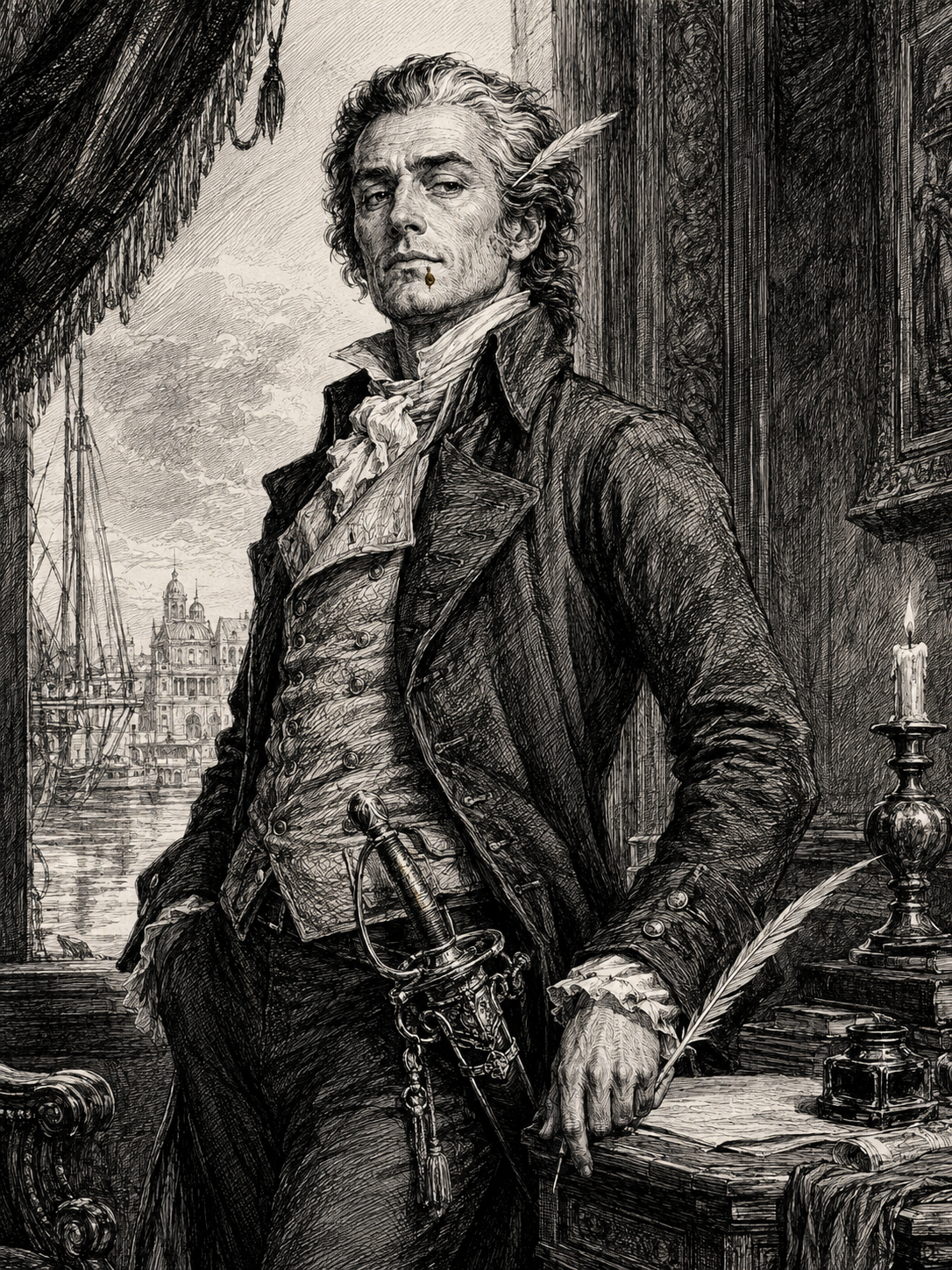
La Plume (“the feather”) is a master swordsman, sailor by trade and poet, also known as Perfume and titled “the Feather of the Liberators of the Americas”. He delivered the last of the seven apocalyptic symbols to a revolutionary, after which he was imprisoned in the Bastille.
Description
- A mature man, “past 35, 40 years”, with a very thin mustache and shoulder-length hair slicked back, seen only when he removes his hat.
- A wide-brimmed, extravagant hat crowned by a flamboyant feather “of bizarre colors” that takes up much space.
- A deep voice that “sounds like the waves of the ocean”; honey-colored eyes that seem to take on the blue of water or the green of grass outdoors; a fragrance that “electrifies”.
- Gloves, a shirt, a heavy cloak with shining work that he hangs up when he sits to write poetry, and sandals “like little pink feathers”.
- Ancient elven armor and a bandolier of cartridges with a pistol.
- A recent pincha from a month earlier, and a small travel bag of items never inventoried.
Arms and fighting
- Rapier and whip, sheathed at his sides; a knife near his chest.
- A huge, highly ornamented katana, worn above the rapier, which he uses to thrust.
- The pistol Satoshi, once kept in one of the expedition’s chests.
- A tall oak staff, and under his coat a mithril chainsaw that also shines; what that piece is remains doubtful.
- In defense he parries with his swords “like a windmill”. He moves with “the speed of the feather”, through the air.
- For light he releases a small stone that floats and circles his head, glowing.
- His fixed ultimatum: “surrender, or be master of your own destiny”.
He is described as strong for a human, very agile and above all resilient; “very charismatic, a braggart, a rogue, a lover of games and challenges, musician, sailor by trade, emergency diplomat, always a defender of oppressed minorities, berserker in battle”. He fought alongside Steve, the boatman, Olafion, Gideon, Magda, Casemiro, Priscina and the frogs.
The feather
His name, nickname, hat, sandals, speed and poet’s pen all repeat the feather. He said in a scene: “You know they call me the feather. Now I see the meaning of that name. It is the white feather.” What the white feather is, where it comes from and what it does are not recorded.
The speaking sword
His katana holds a female spirit that speaks when he draws it: “come, now we are one together, as I always wanted”. This spirit is Tel, the girl with whom he made a pact as a child and who “is now his sword”. The blade bears the inscription: “Does the eagle know what it is in the field? Or will you go as a man?”
The last symbol and the Bastille
Of the seven apocalyptic symbols, “the one the feather delivered was the last to be delivered, and he delivered it to a revolutionary”, 68 years earlier. That delivery was when “he was taken prisoner”; the record places him captive in the Bastille. The symbol remains pledged to his blood: “To my son Lafayette I will give it when he grows up.”
Itineraries
He joined the expedition and stayed at the Hotel Astra, from which he took some things and left alone without saying goodbye. He was also seen in New York, handing out coins and sending letters through the postal system.
In the hymns
In the mythological record he is a fallen amnesiac who “went through great stages” and is now “considered the awakening of a greater cosmic force”, able to “raise a new plane of existence and clone his body, create life and heal a lost soul”.
Conflicting accounts
- His armor is “of mithril” in one version, “made of nitrile, elven, ancient” in another.
- His hair is black in one account, crimson in another.
- In one account Tel inhabits the blade; another calls La Plume himself “a ghost who inhabits the sword”, she also “coming and going from reality”.
Open questions
- What the pincha is (wound, mark, tattoo or badge) and who caused it.
- What the travel bag contains; the record is too damaged.
- Where he went after leaving the Hotel Astra.
- How his imprisonment in the Bastille fits with his later acts in New York, his amnesia, his “great stages” and the delivery of the symbol.