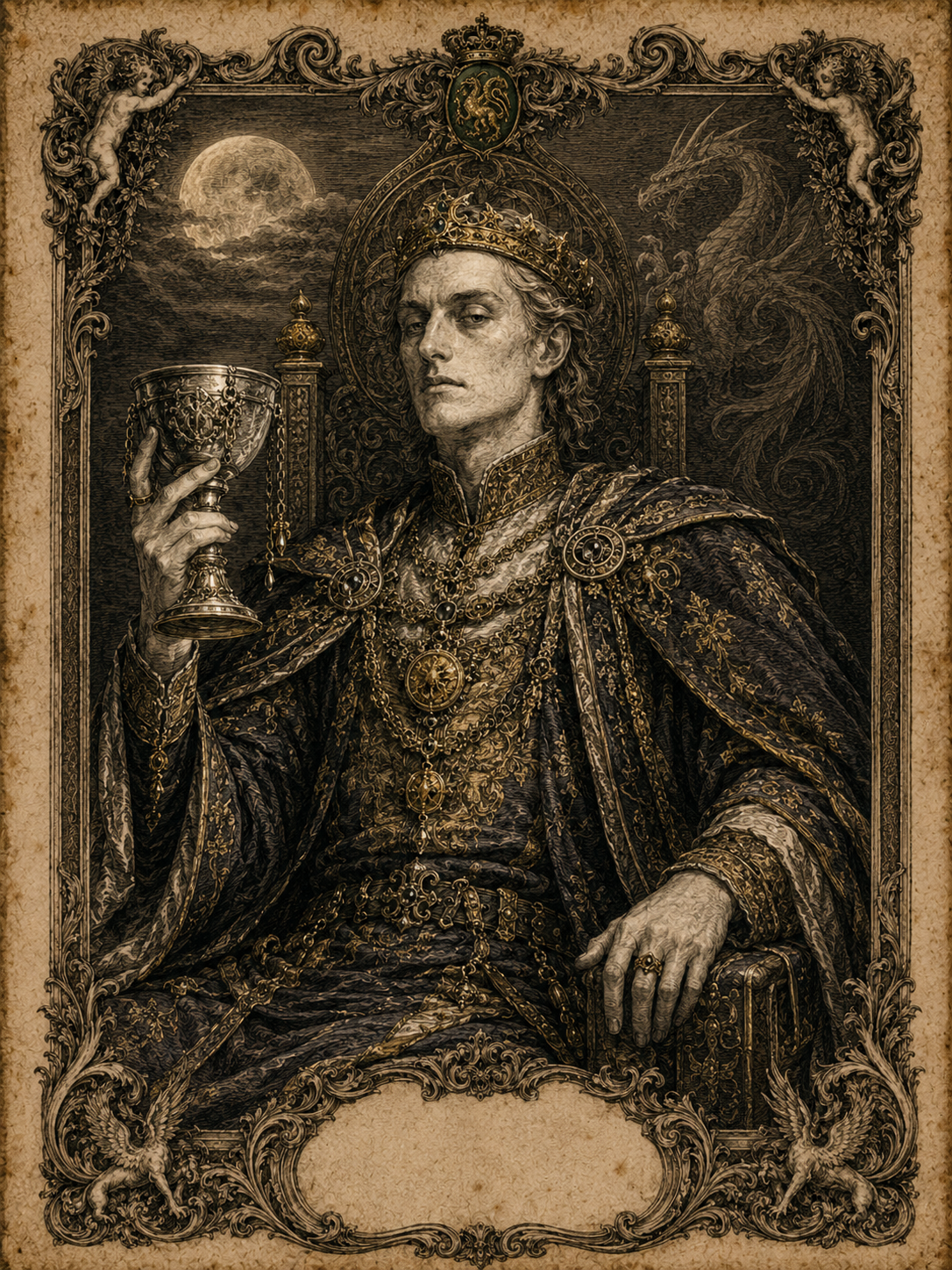
Drusus IX the Pale is the reigning Emperor (Basileus) of the Archontean Empire in the World of Archontos. He came to the throne about thirteen years before the valley’s present cycle, dated 2993 AEP.
| Type | Character |
| Title | Emperor (Basileus) |
| People | Archontean |
| Spanish entry | Drusus IX el Pálido |
Name and dynasty
He is “the Pale” in popular speech, “the Basileus” in liturgy, and “cousin of the throne” only in letters with the Basileon of Burdock Valley. He is the ninth emperor of the Drusus line, a house several centuries old descended from the major Archontean families of the Pact. His predecessor Drusus V opened the Order of Thoth to anyone with magical talent; Drusus IX keeps that doctrine.
He looks aged: pale skin, deep shadows under the eyes, sunken cheeks, veins visible in his hands. At the start of his reign he renewed the Pact of Elías with the seven chromatic princes on Mount Ennio, drinking blood-laced wine from the founding cup. Decadian doctrine holds that the drink drains color from the skin, puts a reflection in the eyes, and deepens with time.
Government
- Prophecies. He consults imperial oracles (hierophants of the Ten in the Great Basilica, sibyls of Mithras in Illyria, augurs in key provinces), and the administration follows them. Critics whisper that some prophecies are drafted in the chancellery first.
- Draconic counsel. The seven chromatic dragons of the Pact, or some in rotation, secretly advise him, attending deliberations in a ritual presence only he fully recognizes, in exchange for treasure, protected territories and secret clauses.
- Selective harshness against heresies (above all the Sortian heresy of the Eleventh, which posits a unifying God above the Ten), rival cults (the revived cults of Set in Narsileon and elsewhere) and ambitious frontier warlords, when church or dragons recommend it.
Supporters hail him as “el que devolverá las águilas al ocaso” (“he who will return the eagles to the sunset”): the recovery, with draconic backing, of the western lands lost after the Schism. Critics in neighboring courts, provincial exarchates and clandestine Theosophist circles call him “puppet of his reptile counselors”.
Court factions
- Paladins of the Renaissance: young nobles and generals for expansion, reform, draconic renewal and opening the Order of Thoth to commoners; many quietly tied to the revived Sortians.
- Old patricians: senatorial families for consolidation, heirs of the Theosophists, wary of magical opening and frequent renewals.
He tries to balance them, without full success.
Role in Ardis Vala
Imperial politics reaches Ardis Vala only faintly; Ritornello and Glastumville worry more about the dungeon and the misty domain.
- He confirmed the imperial rank of the house of Basileon (Lord Burdock, Argus, Alexia, Glastum), granted fiefs to “tame the frontier”; their blood comes from Juliana X.
- He approved the continued Archontean Reconquest under the exarchs of Narsileon and Arcturos.
- He writes to Lord Burdock “to the cousin of the throne, health”.
- His bust is on the imperial gold coins of the valley, which some temples of Mithras use liturgically; his decrees are posted in Ritornello (before its fall) and its successor towns.
Conflicting accounts
- Popularly, “the Pale” refers to his aged complexion.
- Internal chancellery correspondence reads the pallor as the Pact’s mark of draconic validation; a marginal note attributed to a secretary of the Primarch (2987 AEP) says whoever holds the cup inherits its lunar reflection.
Open questions
- Does he know Pope Alejandro Sixto or recognize his authority?
- Does he know what draconic pledge sleeps in Ardis Vala (possibly in the Mega-Dungeon)? Its recovery would fully reactivate or extinguish the Pact.
- How far repeated renewals will deepen the pallor.