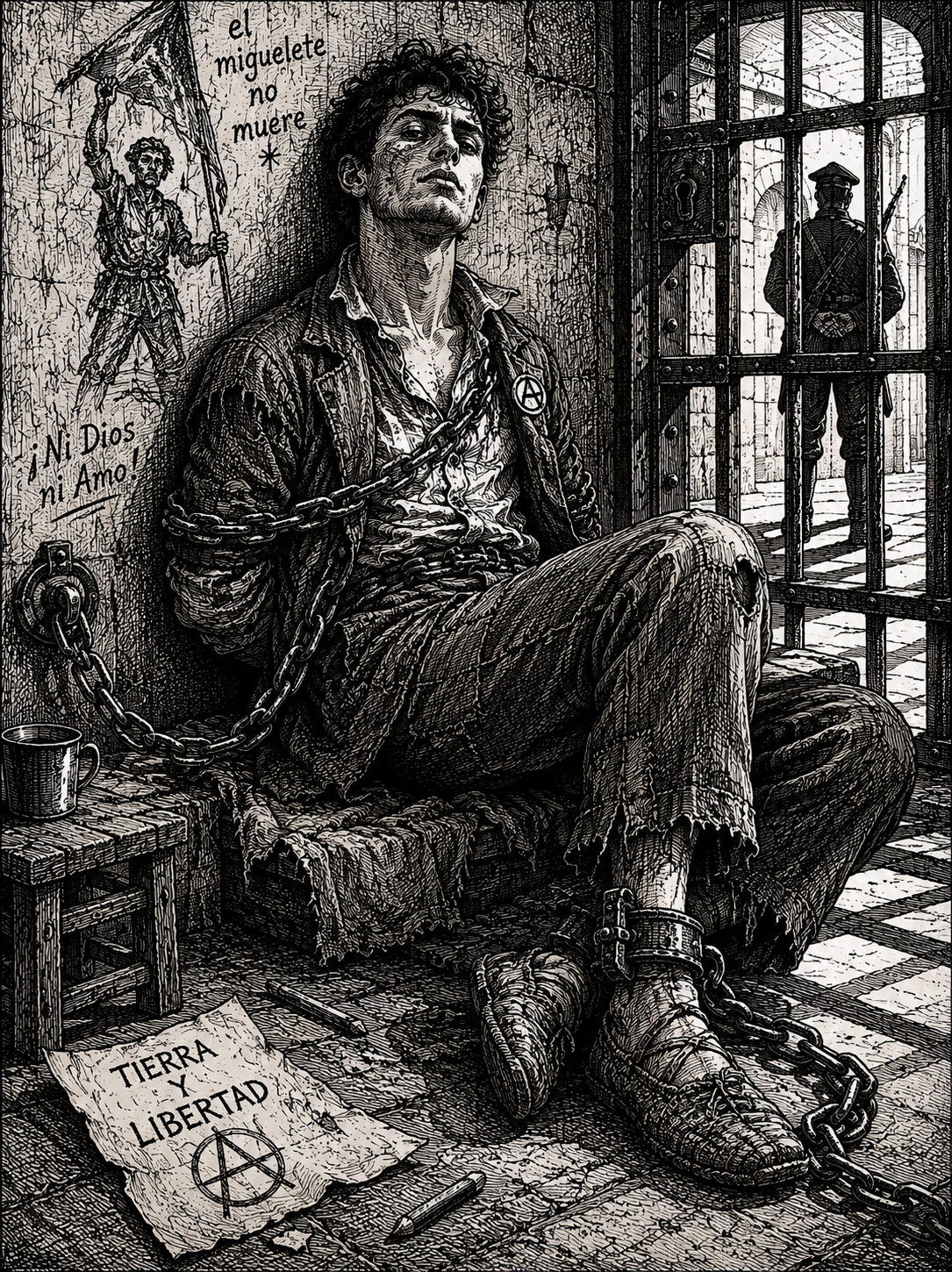
Miguelito is a young Catalan anarchist in Spain in 1888, condemned to death for killing a miguelete, whose failed rescue set off the cycle of the Deep Ones. After his death he became a martyr invoked by the band.
| Type | Character |
| Era | Spain, 1888 |
| Location | Provincial prison cell; transfer to Madrid |
| Spanish entry | Miguelito |
Description
Miguelito is thin and young, with an open shirt and an anarchist “A” sewn over his heart. In his cell he is chained at wrists and ankles, with a folded paper reading TIERRA Y LIBERTAD (“Land and Liberty”) at the foot of his cot. On the wall, scratched with a nail or fingernail, is ¡NI DIOS NI AMO! (“No God, No Master!”) and, smaller, el miguelete no muere (“the miguelete does not die”).
History
He was accused of killing a miguelete (a mountain rifleman of the provincial militia of Guipúzcoa) in cold blood. His sentence was transfer to Madrid and execution by firing squad at dawn on the day after the transfer.
A group that did not know him, but owed him the cause, attacked the cart carrying him near Madrid; this was the first action of the gesta (campaign-cycle) and the rescue failed. Miguelito then became a cause: his name was chanted at later rallies and his “A” was written on the walls of other cells. He initiated Antonia into the cause.
Legacy
- On the last night in Cádiz, when the band hesitated over pursuing the Londra, someone invoked him: “él lo habría querido así” (“he would have wanted it this way”).
- When the princess of Finland offered to pay for the band’s silence, the answer was his name: the kings she represented were those who had him shot in Spain.
- The corrupt Ranger who mutates into an infernal coyote (the Coyote) was recognized by the band as a creature “of the lineage of the day of Miguelito”.
- His figure is the opening scene of the Anarquirón script. The Akashic Records preserve the graffiti el miguelete no muere.
Conflicting accounts
- One passage states that whether he was shot in Madrid or taken before that is not confirmed.
- The chronicle of the gesta and a later addendum treat him as executed, and identify the prisoner of the cart attack and the invoked martyr as the same person.