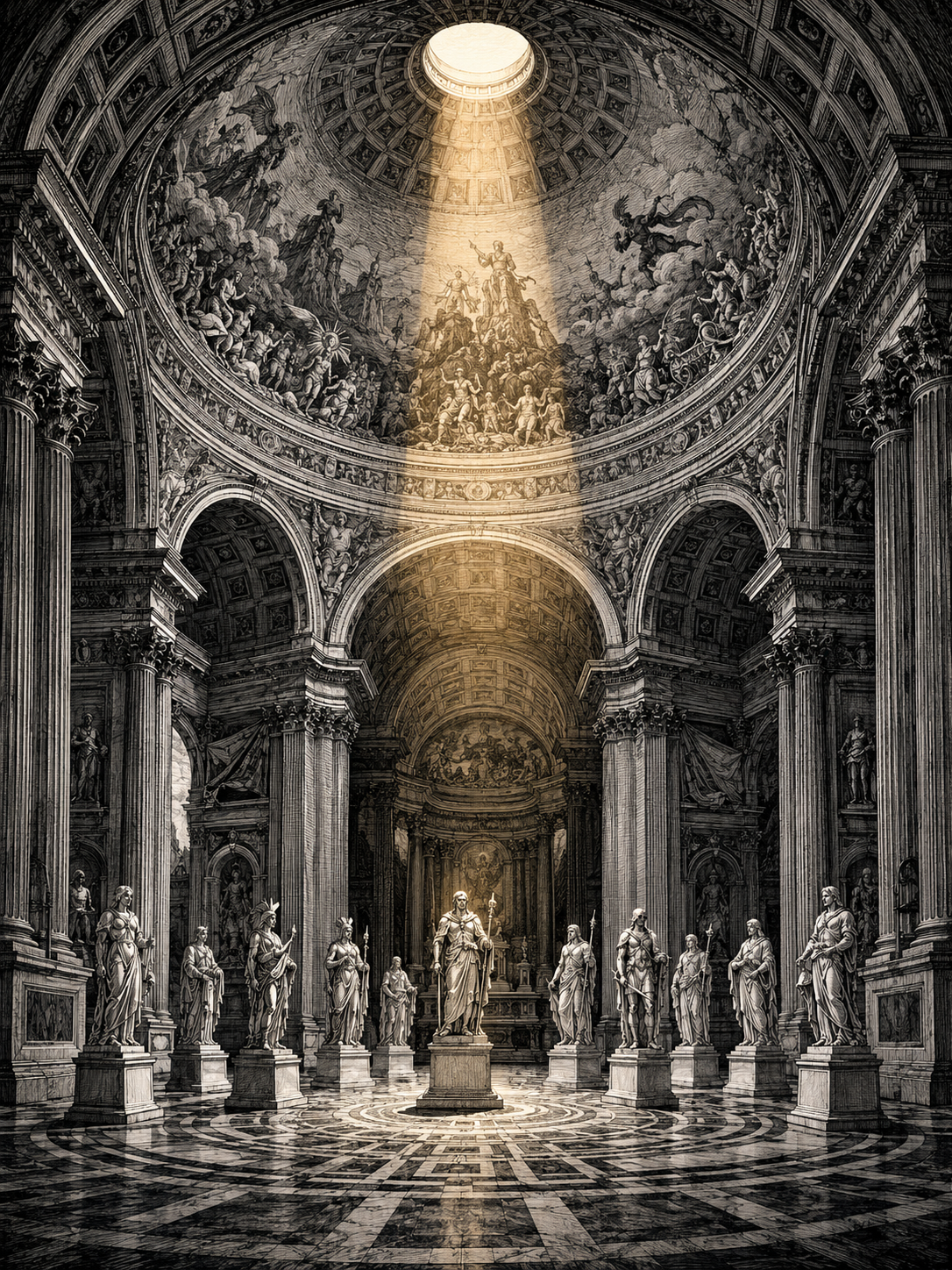
The Panthéon of Paris, in its form in Uchronic Paris on Antiterra, is the central monument of the post-revolutionary era raised after the liberation of 1901. Under its dome stand twelve statues of heroes who are dead for good: it is a Panthéon without resurrection.
| Type | Place (monument) |
| World | Antiterra — Uchronic Paris |
| Era | Post-revolutionary, after 1901 A.D.A. |
| Houses of the Cycle | ⏳ House of Carnal Time |
| Spanish entry | Panteón de París |
Description
The twelve hero statues stand around the central space beneath the dome. Twelve is the number of the zodiacal platforms and of the twelve-year cycles that mark periods of liberation and reorganization of the world.
The statues are a political statement. The post-revolutionary era, which ended the uchronic viceroyalty of Lord Gaul and opened the liberating republic, chose its twelve heroes to be kept in stone.
Without resurrection
The heroes it depicts are definitively dead. The post-revolutionary era has routine time travel in Paris and knows how the magic that restores bodies works, but chose not to use it on its dead. The formula — “Panteón con estatuas de héroes (sin resurrección)” (“Panthéon with statues of heroes, without resurrection”) — is a political and cosmological decision: the dead are honored as dead, not as a resource.
Relationships
- It is paired with the uchronic Arc de Triomphe, the era’s other monument, surrounded by twelve avenues dedicated to heroes. The number twelve also marks the Game of Shadows and the cycles of the A.D.A. calendar.
- Paulus of Alexandria, keeper of libraries after 1901, is possibly connected with the policy behind the monument.
- Notre-Dame is another key monument of the same setting.
- The pantheon of heroes is referred to in the Events of Antiterra.