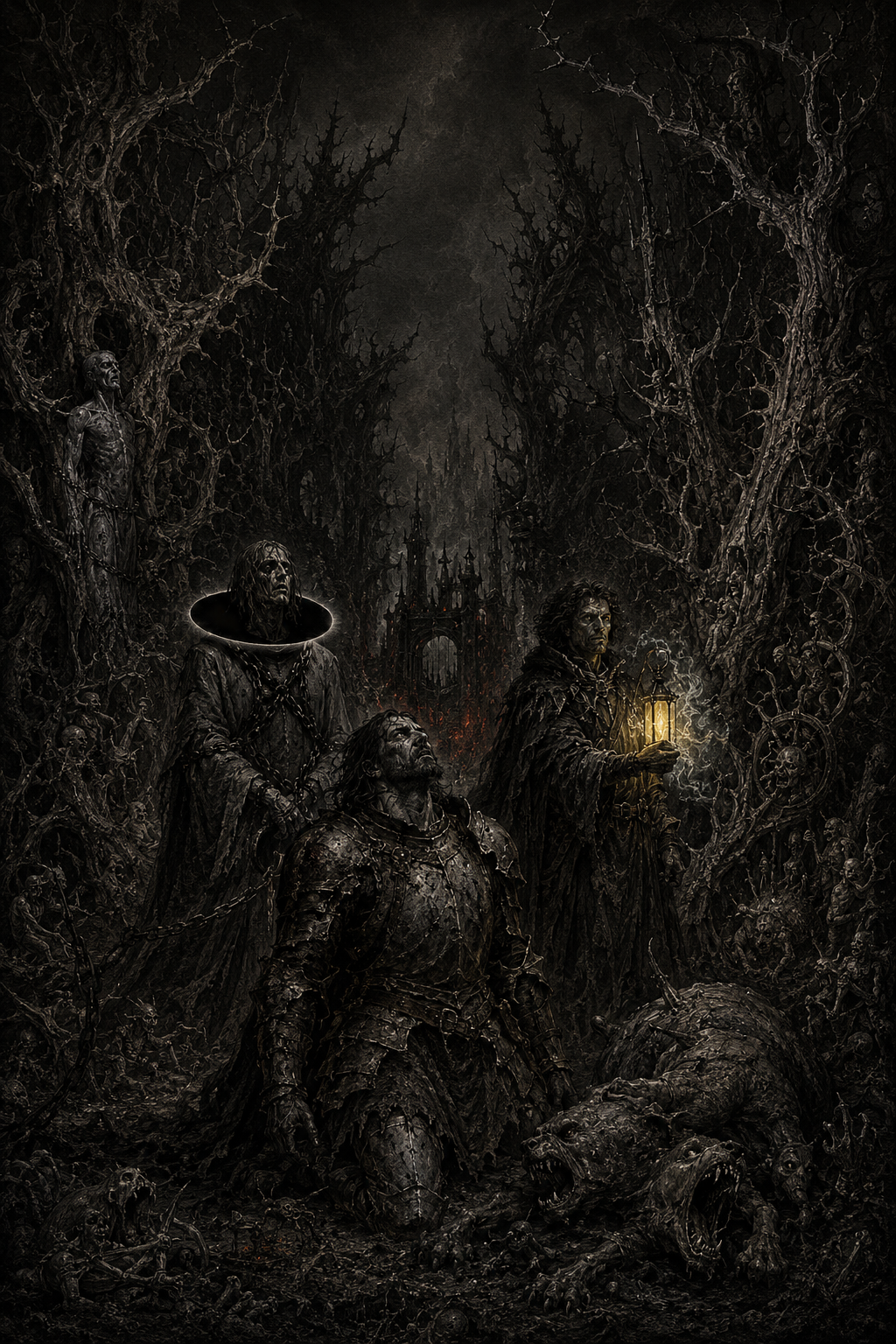
Templar Darkness is a fold (pliegue) of penitence in the form of a twisted forest, where the Order of the Temple does penance for its dissolution without managing to redeem it.
| Type | Concept (fold of penitence) |
| Era | After the dissolution of the Order of the Temple, active in successive cycles |
| Location | Twisted forest with no fixed coordinate; appears wherever a Templar dies unabsolved |
| Spanish entry | La Oscuridad Templaria |
Description
The forest has bodies hanging among thorny branches and a tiny Gothic cathedral in the background, a memory of the institution that no longer protects anyone. Three figures stand at the center:
- on the left, a kneeling knight with a solar halo behind his head, the insignia he kept after the Temple;
- in the middle, an armed martyr prostrate in prayer, head bowed, hands joined, armor wounded;
- on the right, a hooded figure with a lit lantern, guide or executioner (not distinguishable).
Nature
The darkness is not an absence of light but a doctrine. What the Order could not confess in public council it confesses here, where the confessors are the trees and the witnesses the hanged. Whoever enters the fold does not leave unchanged: the paladin usually loses his charisma, the cleric his gift, while the villain prospers.
Reach
- The Temple’s crypt in Paris grazes it.
- The replicating vault duplicates it.
- The vampirism of Numa Pompilius in the Temple of Thoth enters through its threshold.
- It differs from the Gulthias Tree, which works by sap rather than penitence: the tree demands blood, while the Darkness demands a confession that the faith does not admit.
History
The forest emerged after the dissolution of the Order, where the Council left debts uncollected. The Sancta Sanctorum was its predecessor locus, which the Darkness replaced. Hugues de Payens, first figure of the Order, has his shadow enter the fold. The Possessed Templars are a late formation born of it.