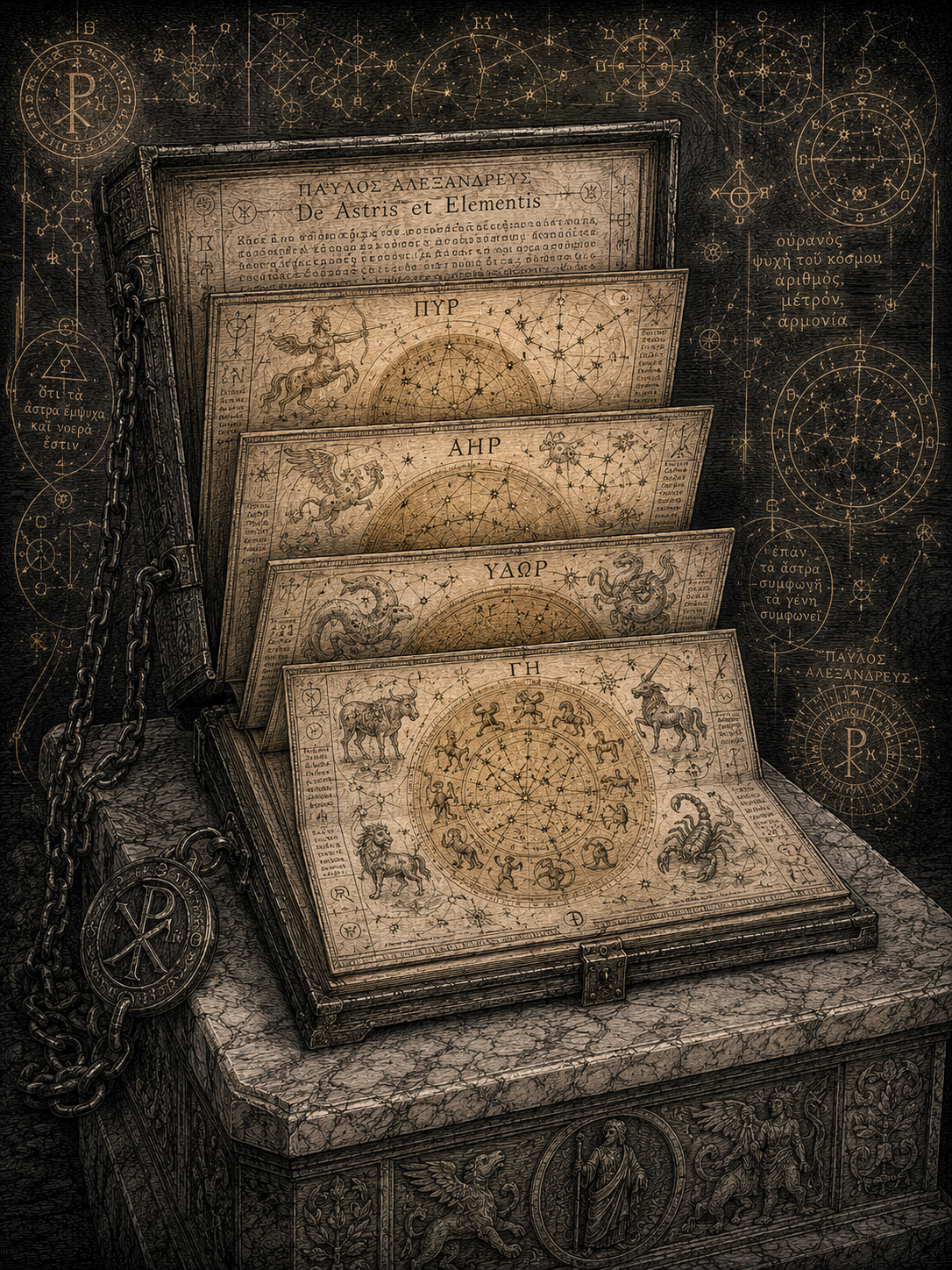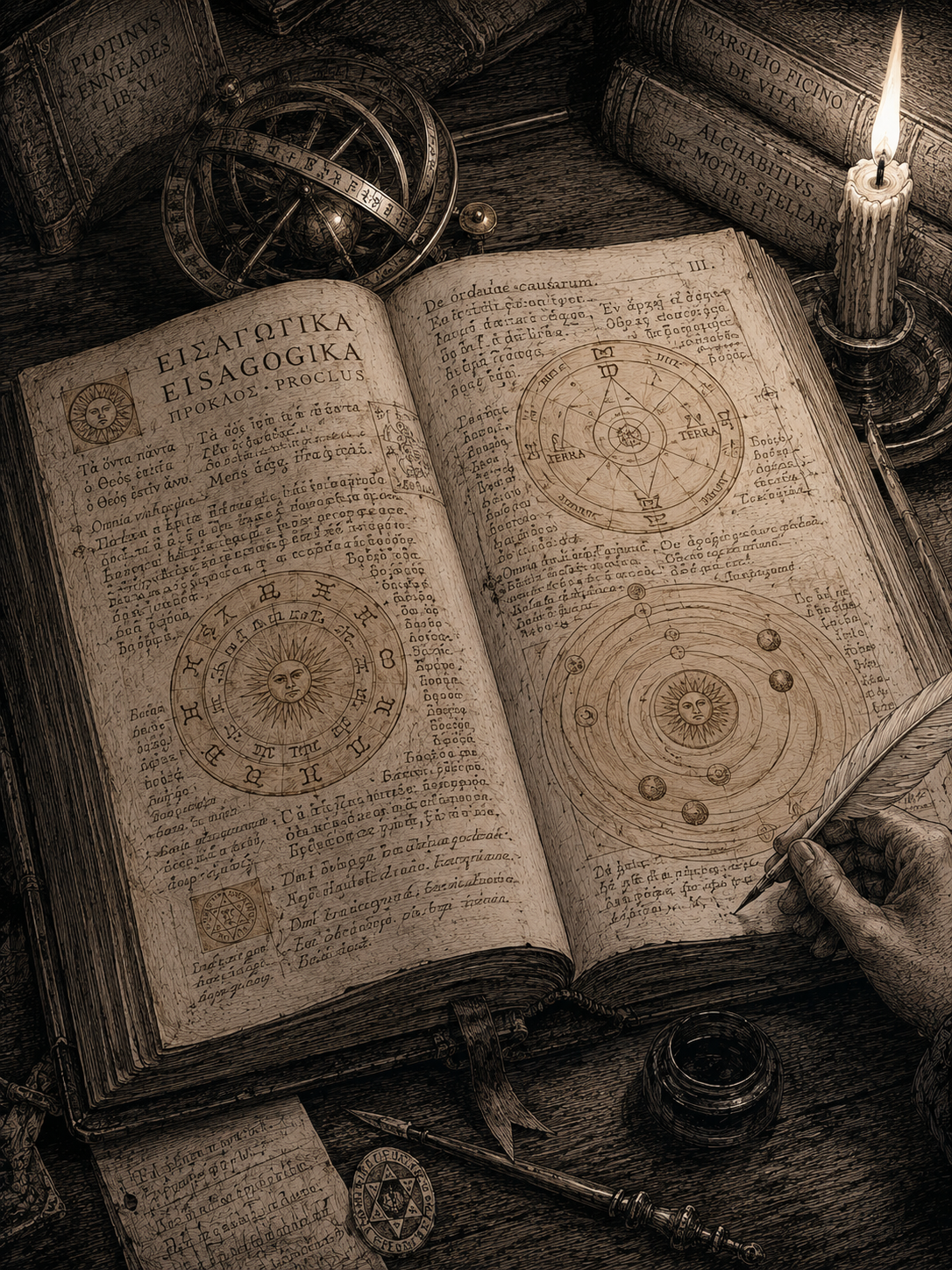
The Eisagogika (pronounced Isagógika or Isagógica) is a treatise of elemental astrology in Greek and Latin signed by Paulus Alexandrinus in Alexandria around 378 AD. It holds the knowledge of the Guardians and the Zodiacal Platforms and is the origin of the world’s forbidden knowledge.
| Type | Artifact (book) |
| Signed | c. 378 AD, Alexandria |
| Houses of the Cycle | ⏳ House of Carnal Time · ※ House of the Name |
| Spanish entry | Eisagogika |
Description
The name, from Greek εἰσαγωγικά, means “introductions”. It teaches far more than ordinary astrology: the cosmological system that sustains the universe under the wheel of the Cakravartin. Everyone seeks it; only Paulus can read it.
In the Uchronic Mediterranean it is sealed, encrypted, grows when examined by one who understands it, and holds knowledge of the future and the forgotten.
One book under many names
The Eisagogika joins all the special books into one: the Blue Book of the Library of Hell, the copy given to Henri in Paris in 1886, and Al Azif (the original Arabic name) are the same book. The Lovecraftian Necronomicon and this book are the same object. As the Blue Book it has a heavy blue binding and an encryption that requires sacrifice to open.
Chain of authors and copyists
- Authors: Paulus Alexandrinus → Helena Blavatsky → Paul Claudel — the same scribe across three centuries.
- 950 AD, Byzantium: Theodoras Philetas translates it into Greek.
- 1051–1055 (1050–1055 in one listing), Byzantium-Constantinople: Olaus Wormius copies it into Latin; this copy is the Black Book of the Law of the Dead / Necronomicon.
- Five colored books (blue, green, red, white, black), copies and variants, go to the Venerables.
History
- Kept in the Infernal Library of the Seventh Circle, it was stolen by the lich Marcos the Mage (Arcoms Cosmar’s necromancer facet), who descended aboard a spider-creature ship to use it to destroy Alexandria in personal revenge. He succeeded. The theft climaxed at the Temple and Place of the Just; the ship left through the Pillars of Hercules into the Mediterranean.
- It was also stolen by a desert Djinn and an invisible Simón. If Marcos the Mage obtains it and reaches Alexandria, the city will burn.
- In the Templar cycle the Templars recovered it through the Flamenco and carried it to Constantinople and then to the vaults of Ur.
- In Paris, 1886, Paulus, as Paul Claudel (a mustached Parisian convert to Christianity), gave a copy to Henri La France in Notre-Dame, warning that the Great Khan wants to profane the sacred Lady inside. Henri must take the book, the key to time travel, back to Alexandria.
Internal divisions
The book has 124 subdivisions, cited as C[n], p.[x]: read as 12 signs × 10 decans plus four faces (per the late manuals of al-Iskandariyy), and also as 100 major volumes, C1–C100, with sub-volumes (C7A–D, C44A–E, C42 BIS…). Both readings hold. C0 precedes the count. Like the Argentum Palace of Graz’zt (a hundred visible rooms, one hidden), it holds an untranscribed C101, kept, per a marginal gloss, en piedra y arcoíris (“in stone and rainbow”).
Gallery