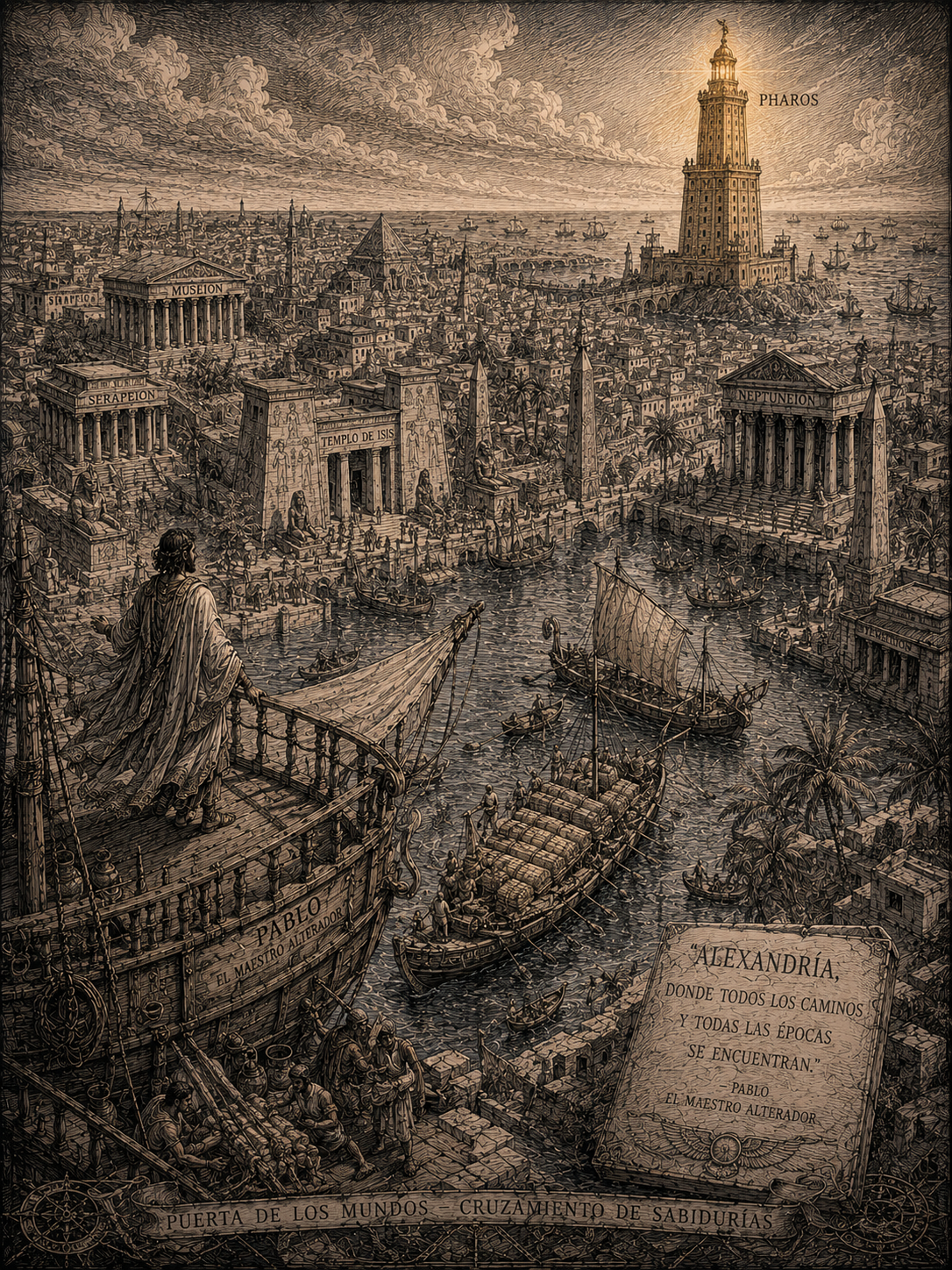
Alexandria is a port city on the coast of Egypt, “the greatest and oldest port in the world” and “the chronal city par excellence”. It is a center of learning, gnosticism and time travel, and its lighthouse is a focus for traveling to other times.
| Type | Place (city, port) |
| Era | Age of Empires (3rd–4th century AD); appearances to 1891 |
| Emblem | A ship with a scale above it |
| Spanish entry | Alejandría |
Description
The city lies between desert and sea, in a fertile zone; it is hot, with red twilights said to be “echoes of the ancient gem that was there”. One of the most Greek cities of Egypt, it is cosmopolitan: Jews, Greeks, Romans, native Egyptians, and people from Libya, Tunisia and perhaps Morocco.
From Carthage (1,500 km) it is fourteen days by sea or ninety-four by land; from the Siwa Oasis, one night’s flight. A northern route leads to Greece, the island of Euca and Spain. Land travelers enter by the Moon Gate (west) or the Sun Gate. The Canopic Way and the Soma Way cross on a hill at the center.
The lighthouse stands on marble over land reclaimed with stones and a concrete-like substance. Its top has eight windows for the eight directions; a statue of Poseidon with trident stood at the summit. It is credited with “twelve valantes” and has suffered attacks. It held “all the great objects of science and magic together”, and with the Eiffel Tower and the Lighthouse of Serpent Island it points to a stellar position, a triangulation for time travel. Beneath it lies the legend of the Crystal Crab, begun and ended by earthquakes.
The library, on the high ground, is attached to a temple; it is a dustless copying hall of scribes and scrolls that also keeps “libraries of oral literature”. It is closed to the public. Its other half is a cavern prison; inmates are lowered in an iron cage by pulleys, a Roman mechanism without magic, and fed dates and spiced wine.
The palace mixes Greek and Egyptian styles, with red inscriptions of the decans and scorpion creatures and some lead-walled areas. The cubic Greco-Roman Museum holds statues of Greco-Roman gods, Anubis and the crocodile god Sobek; the Catacombs of Kom el-Shoqafa are nearby.
The market sells everything, “drugs and women”, and a thick beer. British, French, Italian and American banks operate there; the modern layer has European hotels (the Majestic, the Defense). Specialists in the Jewish quarter, around “the Fabulous”, obtain what is found nowhere else.
Learning and faith
Alexandria is “the city of gnosticism” and the cradle of Hellenistic kabbalah. Masters of time travel are trained there; even Florence knows of Alexandrian sages who traveled in space and time. The Gymnasium is a place of culture and spiritual search. Guards recognize spellcasting as soon as they hear strange words.
The first pope is not Roman but the Patriarch of Alexandria, Dionysius. Christianity and Judaism coexist; a patriarch fled to the desert fifteen years earlier during a persecution. Saint Mark set out from here, and the gnostic Basilides was consulted here on the persistence of war.
History
- Alexander the Great founded it on the village of Racotis, inspired by Amun, after an omen of doves. The library burned in Julius Caesar’s time.
- 260: martial law; an enemy fleet besieges the city with catapults while its own fleet sails out. Tension with Palmyra, but no war. Two coinages, new and old gold, circulate. Later the curfew is lifted amid street rebellion.
- 1055: under the Byzantine Empire.
- c. 1769: under Arab rule, decayed, at times “a second-rate summer resort”.
- 1891: the British seize it, the Devils’ counterattack, with Alexandria as the final bridge of that gesta (campaign-cycle).
- The courtier Timagenes surrendered the city without bloodshed.
Alexandria is “what Rome needs to survive” and the mission’s declared destination. Marcos the Mage plans to devastate it in personal revenge and seize the library. A prophecy says the library will burn again; its important part was transferred before its destruction. The Regulators use the city to send and gather people. Spirits haunt it, among them the husband of a dead companion.
Other Alexandrias: Alexandria-Virginia, a replica city of sages with prophecies about the forces that bring the aberration; a chronal Alexandria in another uchronic time (“this happened in 1120”); and the Luminous Alexandria portal, closed by guardians.
Conflicting accounts
- Alexander founded the city; another account records “the first Alexandria” founded by Pablo with Halim, a Syrian.
- Pablo is a resident ally of the mission, the only one able to reveal the magic book’s secrets; there is also “a certain Pablo of Alexandria, accursed”, linked to the theft of the knowledge of fire, betrayed formulas and the attack on the Regulators. Whether these are one figure is unresolved.
- The lighthouse is 40 m high in one account, 120 m in another.
- Prisoners descend “three at a time” or “one at a time”.
- The 260 exchange rate is given as 330 to 3,300 gold coins, or as 33 to 330.
- The terrain is called very flat, yet the city lies “in the middle of a hill”.
Open questions
- What the “twelve valantes” are, and whether the lighthouse and statue still stand.
- Who was expelled from Alexandria.
- The enemy fleet’s name in 260 (garbled) and who guards the Luminous portal.
- The layout of the main buildings and the population.