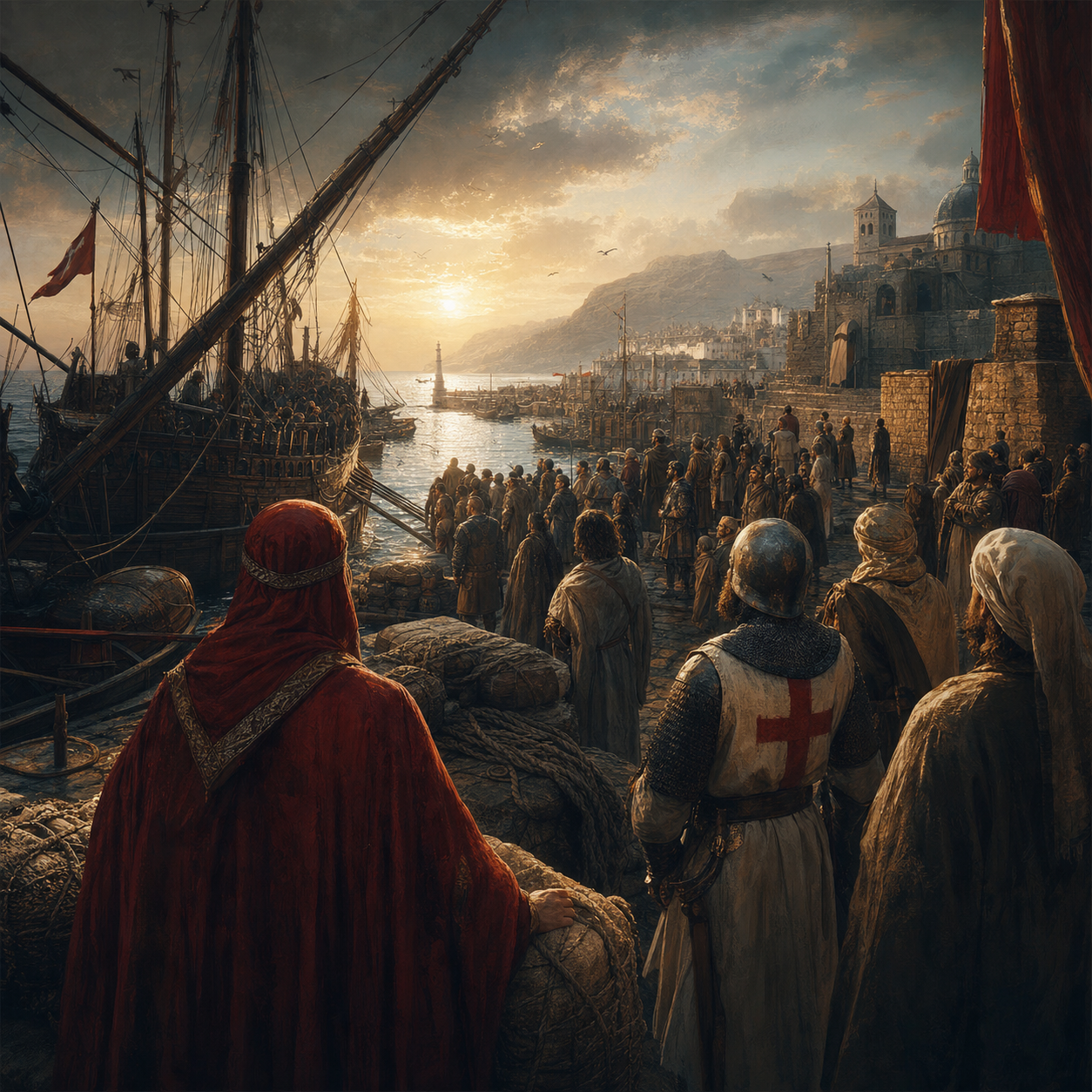
Famagusta is the capital and main port of Cyprus around 1300: a small fortified town whose harbor mouth can be closed with chains, called “the Reims of the Mediterranean” and “the last bastion of the West in the East”.
| Type | Place (port city) |
| Location | Cyprus |
| Era | 1300 |
| Chronicle | florenzen |
| Spanish entry | Famagusta |
Description
On the maps used by those sailing east, Famagusta is “marked with white crosses as if it had the plague”. The town exists because it is the entrance to the island and must be closable. It is entered from the water: a corniche (a transverse street), a crenellated zone, and two protected towers with catapults on either side. Chains seal the harbor mouth; once inside, “you are at their mercy”. The garrison is “very organized”, with crossbows (balletas), swords and archers. Whoever controls the harbor mouth controls all maritime movement in the area.
At the other end of the town a Gothic cathedral is under construction and unfinished. It is visible from the town and earns the place the name “the Reims of the Mediterranean”, a declaration that “this place is still European”.
The town is squeezed into a strip: beach and sea in front, mountains and higher fortresses behind, the cathedral to the sides. A tavern on the water side “faces the beach and the sea. Not cliffs”; with no cliffs, the town’s defense is entirely artificial. The rest of the island lies “at least 100 kilometers” away.
Rule and role
A wrathful king rules Famagusta. Famagusta is the operational point of departure for the East. A company arrived by ship and set out from here on its expedition; in the recorded stretch it is placed east of the town, with the coast as the route by which others come.
Conflicting accounts
- The king’s ailment is said by some to be epilepsy, by others a curse.
Open questions
- Whether the white crosses mean real plague or only a cartographic mark is unknown.
- The names of the king, the cathedral’s dedication and the tavern are not recorded; nor are population, military command, or the power the town depends on.
- Materials, colors and condition of walls and towers are not recorded.
- Whether “la venta”, mentioned beside “where the capital is”, is a place name, a type of establishment or noise is unclear.
- How far east the company camped, and whether the tavern lies inside the walls, is not recorded.