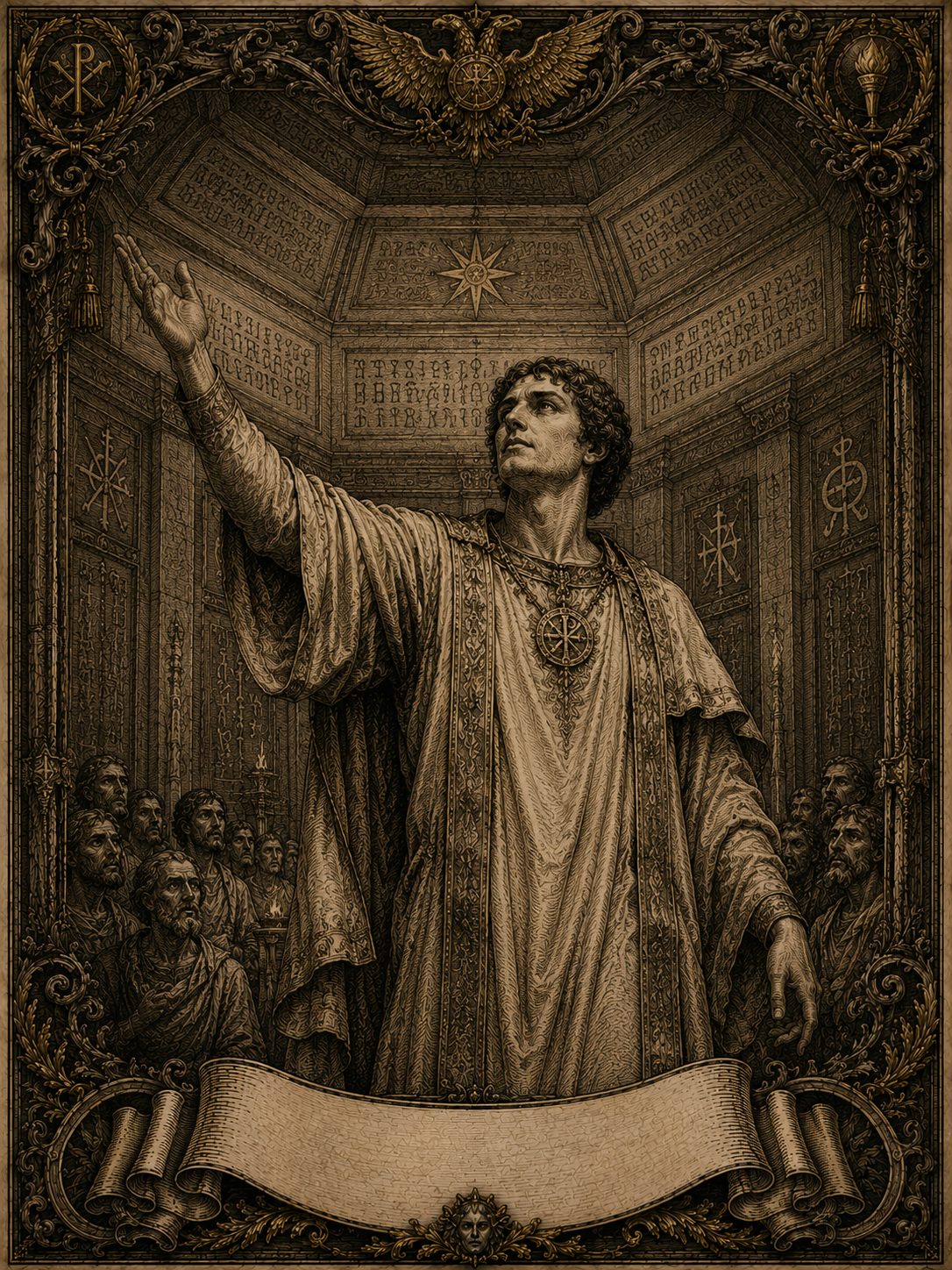
Priscus Pulcher is the martyred leader of the Sortians during the Magical Schism of the clergy of Thoth in foundational Ardis Vala. His doctrine that anyone with the magical spark must be trained was later adopted, without his name, by the reforms of Drusus V.
| Type | Character (historical figure) |
| World | World of Archontos (Archontean) |
| Spanish entry | Priscus Pulcher |
Name
Priscus Pulcher (“Prisco the Beautiful”) is the canonical form of the imperial archives and the chancery of Narsileon. Prisco Electe (“Prisco the Chosen”) is the popular form of the valley, probably a dialectal corruption, or in another tradition a title given by his followers after his death. The modern Priscians, a hermetic order of the Floor of the Great Chasm in the Mega-Dungeon, take their name from him; some hold they claim both forms as one figure.
Doctrine
As spokesman of the Sortians, the faction defending the open spark against the Theosophists and their hereditary transmission, he held that:
- the magical spark is personal talent, not inherited property;
- every bearer must be trained, regardless of social, ethnic or cultic origin;
- the Empire and its magical knowledge will be the better for it;
- cosmic order is restored, not harmed, by this openness.
The closing formula of his sentence, reserved for major pronouncements, makes it sacred text for the Sortians and ritual blasphemy for the Theosophists.
The message in Mithric
The victorious Theosophists purged the parchment copies. The sentence survives only engraved in Mithric on an inner plaque of the octagonal chamber of the Forum of Set, which lights up and sounds only when rubies are set in the eyes of the great statue of Set, the Theosophists’ god:
“Todo el que posea la chispa debe ser entrenado sin importar su origen. El Imperio será mejor por ello. Yo, Priscus Pulcher, he hablado.” (“Whoever has the spark must be trained, regardless of origin. The Empire will be better for it. I, Priscus Pulcher, have spoken.“)
History
- c. 1800 AEP: leads the Sortians; c. 1775 AEP: martyrdom (see below).
- c. 2400 AEP, reforms of Drusus V: the Order of Thoth opens to anyone with magical talent. The Empire adopted his thesis without naming him, since naming him would have canonized a heretic: the doctrine yes, the name no. Since then bishops of the Imperial Church honor him privately, in conclaves of the upper clergy, secondary manuscripts of the Great Basilica and tolerated, unofficial commemorative masses.
- First cycle of the valley: the Seekers of Ardis Vala, unaware of his doctrine, set the rubies in the statue’s eyes and activated the message. The Decadian chronicler records this open group of mixed talents as a “doctrinal echo” twelve centuries later. Bayrum, bearer of the golden griffin shield of Argus, came to sympathize with the Priscians.
- Present cycle: the Priscians, whose current archmage is Nerub Null, carry on his legacy; the Arcanum Forge is a Sortian site still in use.
Conflicting accounts
His death:
- Burned in a public square of Ardisvala at the military end of the civil war, c. 1775 AEP, with other Sortian leaders.
- Escaped, burned, to the ruins of Ardisvala and taught apprentices in secret for years (preferred by later Sortian hagiographers).
- Never died, but was transformed into an imperishable figure of the Floor of the Great Chasm, active under another name (minority version of the modern Priscians).
The activation condition: either Priscus meant only those who grasp the complementarity of the two cults to receive the message, or later clandestine disciples placed it in the adversary’s shrine, which the Orthodoxy would not purge.
His portraits: cult portraits later commissioned by the Decadian Orthodoxy do not survive; they were lost in fires, destroyed by the Theosophists, or never existed (“the martyr preferred the word to the image”).
His figure: a reformer defeated militarily but victorious doctrinally (imperial reading); a heretic whose doctrine infected the Empire (theosophist reading); the founding martyr of the Priscians (Sortian reading); or a transformed figure still active (internal Priscian reading).