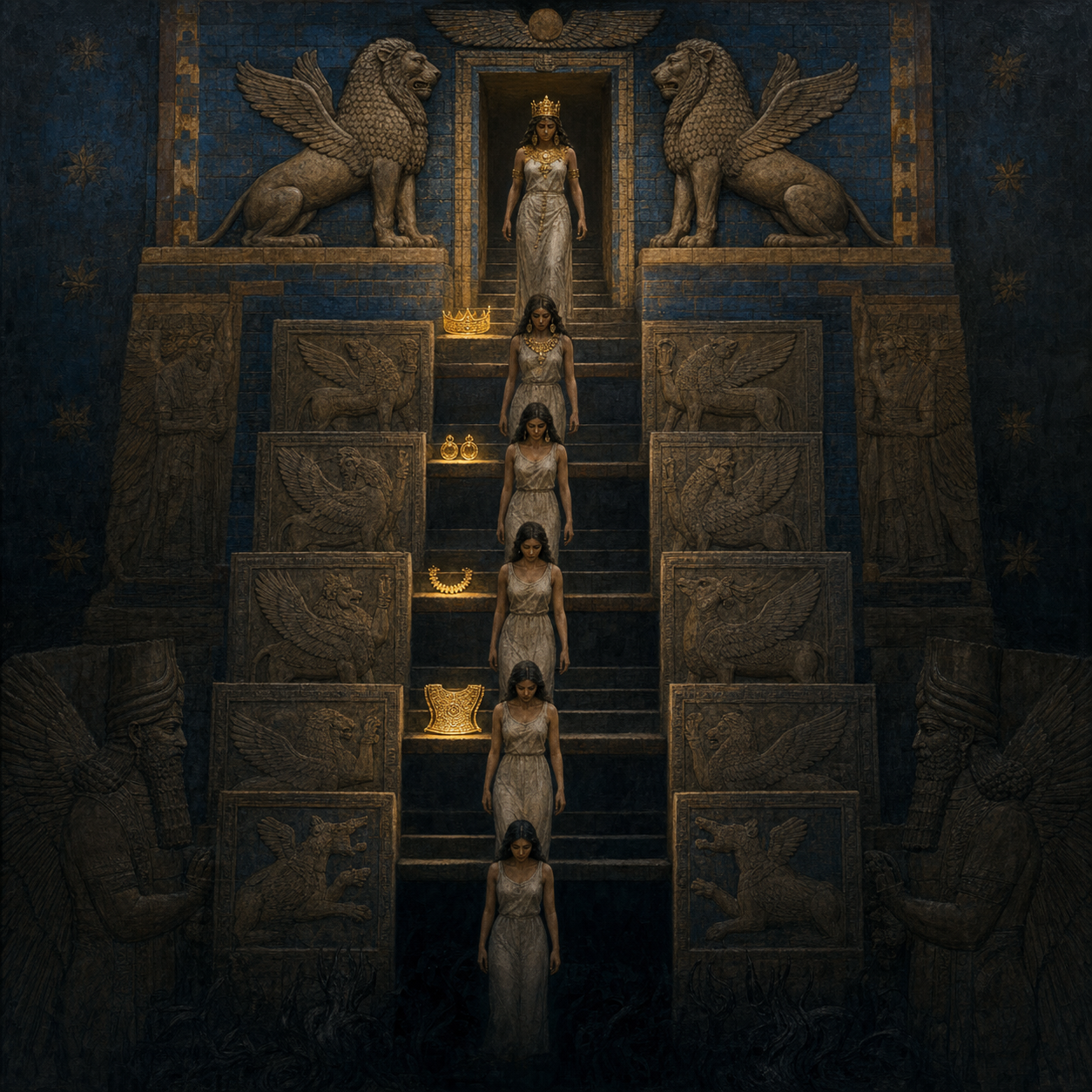
Ishtar (Inanna to the elves, Astarté to the Canaanites) is the chief goddess of love and war in the pantheon of Vala, daughter of Anu and sister of the goddess of death, “a triple, feminine deity”. Her descent and cyclical return organize the calendar, farming rites and much of the world’s worship.
| Type | Entity (goddess) |
| Chronicle | vtc |
| Spanish entry | Ishtar |
Signs
Her annual liturgy opens with a threat to the gatekeeper: «haré levantarse a los muertos y se comerán a los vivos» (“I will raise the dead and they will eat the living”). Her visible form is Venus, “the star of Ishtar, Vespertine”, whose 260-day cycle measures human time. Her insignia are the seven garments she removed gate by gate to descend (sandals, dress, necklace, breastplate, crown), the seven-pointed crown last. Her mark is seven marks on the body, “like black”. A statue of “Rechigal Ishtar” shows the descended Ishtar.
Pairs and sevens
- Her sister, death below, jealous, imprisons her in the descent; her altar is where “life and death meet”, her temple both fertility house and underworld gate.
- Dumuzi, her lover, crossed the seven gates to rescue her; one enters as the other leaves, making season and harvest. Her return requires “the water of life and food and drink”.
- Sevens: gates, garments, crown points, curse marks, and temple levels “of the seven dusts, the seven planets, the seven wanderers”.
Temples
A “traditional” cult, with that of Lil. Temples stand in Uruc (“far away”, where the hierogamy begins), Nivena and Lonia, and Nesut Biti (founded “perhaps a hundred years ago”, served by the priestess Halrua Ishtar Enzi). A remote temple, far from trade routes, stands on ruins of the world’s first inhabitants, reached down underground stones and linked by a corridor to Double Vault. Temples need an undercroft, threshold altar and local copies of the garments, and double as barracks with archer guards, “usually only two”.
Worship
Invoked with «¡Te invoco por los registros akáshicos! ¡Oh, Ishtar! ¡Ayúdanos!» (“I invoke you by the Akashic records! O Ishtar! Help us!”), she answers and gives magic items, but her lovers end badly. Offerings include a ring. Devotees take the vegetal vow: no marriage while serving. A Cape of Ishtar, held by a mortal, works in combat. Luigi Vampa stole the local copies of the garments; someone declares they are gathering her artifacts.
The curse
The artifacts keep the dead below and are guarded under oath. Removing them from the underworld brings seven black marks and transformation into undead, even of her priestess: “The dead will walk the earth! We must return to the artifacts!”
Relationships
Tiamat belongs to the first generation of gods, before her. Shiga holds festivals alongside hers and those of Peace. Her Nesut Biti followers destroyed another cult’s temple and are at odds with Marduk and the followers of Gilgamesh.
Conflicting accounts
- “Rechigal Ishtar” is either a title of the descended Ishtar or a mishearing of her sister’s name (spelled Erech Yigal, Ereg Shigan).
Open questions
- Whether “Kalim” is another name of hers or a separate deity.
- What the vegetal vow forbids beyond marriage; who officiates the hierogamy; what the invocation’s “Akashic records” are; where the remote temple lies.
- How many artifacts exist, what the Cape does, how “Andel” relates to the undead, and whether returning the artifacts reverses the curse.
- Which cult’s temple was destroyed in Nesut Biti.