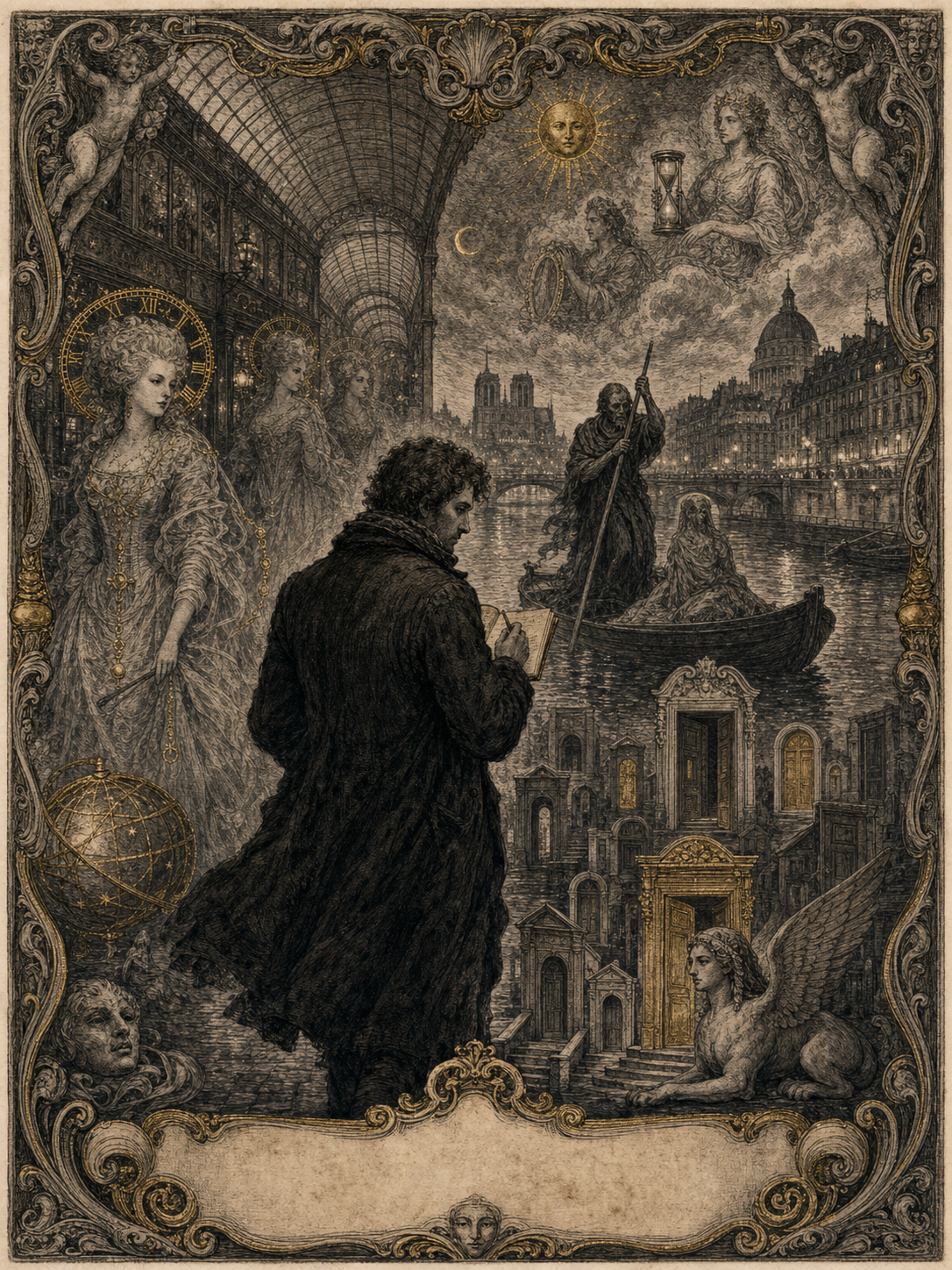
Paris of the Arcades is the Parisian notebook (C42) kept by the chronicler during his stay in Paris from late December 2010 to January 2011: a mix of diary, logbook and dreams. The Plata archive treats it as the birth certificate of several figures of the shared cosmos, among them the Cronoputas (“chrono-prostitutes”), the Charon of the Seine and Mohlitz’s place in the cycle’s visual pantheon.
| Type | Work (notebook, diary) |
| Dates | 13 December 2010 – 17 January 2011 |
| Spanish entry | París de los Pasajes — cuaderno parisino |
Description
The chronicler, unnamed here and writing in the first person, spent the last week of December 2010 and the first weeks of January 2011 in Paris, staying in an apartment, en route to the Sackler Library and Egyptology in London and Oxford. In the notebook he calls himself a goloso burgués (“greedy bourgeois”), a thirty-three-year-old traveler, a reader of Walter Benjamin and Guillaume Apollinaire, whose paragraphs confuse sleeping with walking.
An entry of 16 December reads: “Puede ser verdad que París funcione como ciudad de las puertas. Cada pequeña vida, incluso, entra en resonancia con su futuro.” (“It may be true that Paris works as a city of gates. Even each small life resonates with its future.“)
Entries
- 25 December — At the bar Vieux au Châtelet, facing the Seine with the Eiffel Tower to his right, he recalls Turner’s last words, “The sun is God”, and Umberto Eco’s distinction between appreciating beauty and wanting to possess it.
- 27 December — He seeks the arcades of Benjamin’s project, among them the Passage des Panoramas: narrow, cold, glass-roofed, with semi-expensive restaurants and collectors’ shops; outside, boulevards of theaters and prostitutes in furs. Deaf-mute women had him register his name, address and country on a sheet; a blue-eyed girl kept asking, miming a kiss, until he gave her ten euros.
- 29 December — Dream of a pool with a floating Falcon.
- 31 December — The boulevard of the rich, the Two Worms, a Parisian contact.
- 1 January 2011 — Nap, sudden cold, dream of the worm-platform.
- 17 January — Last Parisian note, at the White Horse, where two men talk about music festivals. Notebook C42 then moves on to other matters: Constant, Benjamin Schmidt, Borges, Browne’s Religio Medici, the Customs of the Dreamscape, Resnais’s Marienbad.
The Charon of the Seine
In the dream of 28 December a stagecoach crosses the Seine at full speed, its black horses striking sparks. In it rides the miracle doctor with his automaton Olimpia, carrying clients who escaped Charon. “El viejo barquero ha visto su trabajo frustrado por un puente de hierro forjado, que cruza el Estigia. Ya no es su propio río.” (“The old ferryman has seen his work frustrated by a wrought-iron bridge that crosses the Styx. It is no longer his own river.“) This is the origin of the archive’s Ferryman, later moved to Montbron and the valley crossing.
The Eiffel Tower
Seeing the tower rise, its top lost in cold mist, made him cry two tears, first from the right eye, then from the left. He read it in Benjamin as the capital of capitals and the culmination of the nineteenth century, and confirmed it standing on the Pont d’Iéna. In the shared cosmos the tower begins here; the Tournament, the impalement of Seth, the intervention of Zeus and the Great Khan’s stopping of time in Uchronic Paris come later.
The guardian of the law of Buddha
At the Quai Branly museum, which disappointed him, he remembered only a terrifying guardian of the law of Buddha with a crab-hilted sword. The Plata archive suggests “crystal crab”; the hilt later enters the catalog as the Crystal Crab, whose owner the archive has not fixed.
The Cronoputas
The dream of 2 January 2011 describes the prostitutes who tend the city’s passages, called the triple T or women of pleasure, an evolution of the lamias. The best of them, daughters of the prince of shadows, became the police and the ferocity of the city. “Cada una lleva un pequeño portal temporal. Son las crono putas. Son hijas de la criatura épica parecida a una esfinge. La triple te hace alusión a los tres tiempos importantes: pasado, presente y futuro.” (“Each carries a small time portal. They are the chrono-prostitutes, daughters of the epic sphinx-like creature. The triple T alludes to the three important times: past, present and future.“)
This is the origin of the Cronoboys, later the chronomantic system of the Palace of Time, with Iriarte signing contracts. The archive uses “the Triple Te” (TTT) as their secret, respectful alias; the notebook’s name is the true one.
The same dream gives the metal spine at the center, founded by special engineers and forged on the anvil of time, “no longer tended by Pablo”; the workers were drowned in the river, and from the remains were made trains that cross space like metal larvae, with the warning “beware the monopoly, the city in a heart”. This is the origin of the Anvil of Time of Pablo, which keeps Paulus as forger.
Mohlitz
Mohlitz entered the visual pantheon of the shared cosmos through a gift brought from Paris. His dreamlike, impossibly detailed scenes became, for years, the archive’s reference for imagining the Reunited around the fire near Eagle’s Peak.