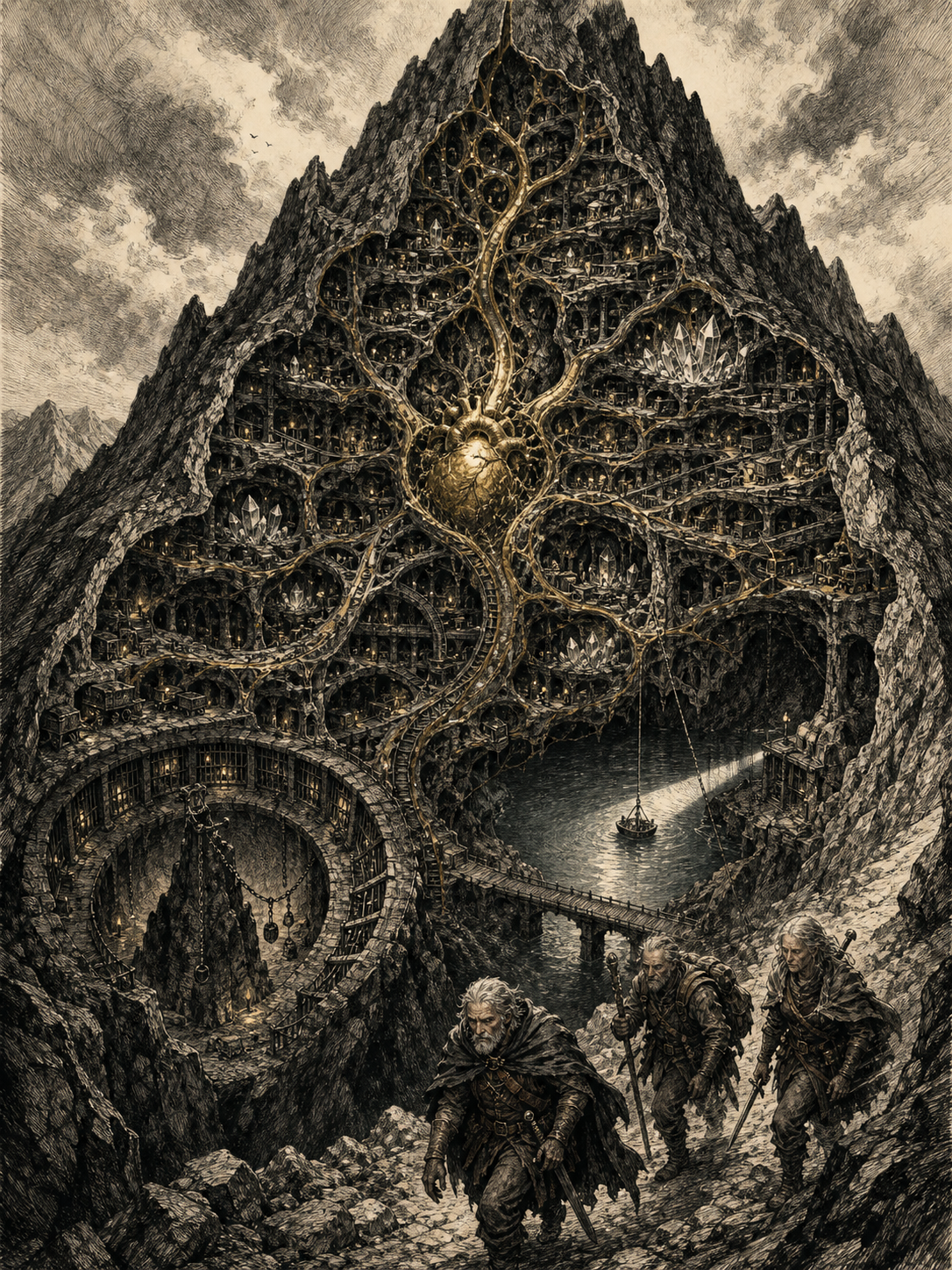
Mount Nevermind is a hollowed, inhabited mountain of Antiterra, the cavity left when someone in the south excavated to raise the Mount of Purgatory, the earthly presence of the celestial mount. It acts as a beacon that holds the known world in place and is besieged by hosts from several planes.
| Type | Place |
| World | Antiterra |
| Other names | White Dominion; Mount of the Watchers (by air) |
| Related | Mount Analogue |
| Spanish entry | Monte Nevermind |
Description
The mountain is told two ways. Seen from above it has several levels, laid out “as if it were purgatory on the way to the earthly paradise”, with paths rising to a seventh level made of the sky’s light that cannot be climbed. Seen from inside it is “like a Gruyère cheese”: labyrinths bored into rock, connected cavities and underground rivers running through its entrails. In the single account of its origin, the excavation for the Mount of Purgatory left this hollow: the mount above is the offering, Nevermind the cast.
Inside, a waterfall drops into the pool where bathyscaphes used to arrive, so the hollow served, or serves, as a port. Above, a metal hatch, probably mithril, cuts off the flow when closed. Its rooms hold large matted red mattresses under a heraldry of roaring lions, and an old gnome brings soft breakfasts of scrambled eggs.
The mount has its own law: the pedlan had rules on whether one could hunt. Anyone interested in the Contest of the Horseman of War must go there, since the contest is decided in its name. It also houses first-rank sorcery: one figure is called “the best of the sorcerers of all Montenevermine”.
The ascent
Climbing the seven levels is the closest thing to finding the earthly paradise, “or at least the stairs of purgatory”. The mount is analogous to the Celestial Mount, its presence on earth; Purgatory “was also known as the Mount Analogue”. Of the Norwegian Mount it is said only “if the Norwegian mount lost it”. Anastasia is also tied to the site (“Anastasia has nothing less than the analogous mount”), though another voice contrasts it with “Anastasia’s place”.
Beacon and stronghold
“Like it or not, it is a beacon.” While it stands it holds the world as it is known: “wherever this mount falls, everything you know of the place you come from will stop being as it was, and it will all be much darker.”
The whole mountain is on a war footing, with defenses against invasions and demonic attacks. It is surrounded by daemons and by hosts of several planes, with groups, ships and things that come from below; daemons inside it mine the souls of angels, and the angels, its beings, would never accept a demonic invasion. Refugees from the Mount Analogue settled in Port Royal, with descendants living in Paris.
Conflicting accounts
- One account places Mount Nevermind “in the Sudetes area, not very far from Prague”, among the stops nearest the start of a journey. Another places the Mount Analogue in the far south, at Antiterra’s South Pole, reached from Italy. They may be two ends of one bore or incompatible locations.
- One voice holds that the Mount Analogue to the Celestial Mount “is now on earth”; another, that “when it existed as a place on earth… in this instance it is not”.
- It “is much farther than it seems”, and “planar barriers” now block the sea route that once reached it.
Open questions
- Who excavated the Mount of Purgatory, when and how is unknown.
- What the planar barriers are and who set them is not recorded.
- Whether the underground rivers, which “stop the mount”, support or block it is unclear.
- Who rules the mountain and commands its defense is not recorded, nor the content of the pedlan hunting rules.
- How the hatch, waterfall and pool relate to the entrances is not stated.
- One ambiguous phrase leaves open whether the mount is an invisible city.